

Episode #73
Jo Andrews
Down the centuries the Bayeux Tapestry has exerted a powerful hold over many imaginations: it was taken to Paris by Napoleon to rally his troops as he planned to invade Britain, and later eyed by Hitler for the same reason. But it is much more than a beautiful object. It is a brilliant piece of communication and in this episode, with the help of Michael Lewis, Curator of the Bayeux Tapestry at the British Museum, we look at the labour behind it and the story it was designed to tell.
Notes
Michael Lewis and David Musgrove’s book is called The Story of the Bayeux Tapestry and it can be found in the Haptic and Hue UK Bookshop and the Haptic & Hue US Bookshop Michael can also be found on Instagram as https://www.instagram.com/tostig1066lewis/
There is more information about the Bayeux Tapestry at the British Museum at https://www.britishmuseum.org/exhibitions/bayeux-tapestry This includes details of the next ticket release on October 21st for the public or on October 6th for Friends of the BM. Until then all tickets are sold out.
There are also a lot of new books being issued and re-issued to celebrate the exhibition and the events surrounding the creation of the Tapestry. The best place to find these are in the British Museum’s bookshop. https://www.britishmuseumshoponline.org/exhibitions/the-bayeux-tapestry/books-the-bayeux-tapestry.html
Friends of Haptic & Hue have adopted Bayeux Stitch at the Royal School of Needlework’s Stitchbank and if you would like to find out more about the stitch or even try to re-create it for yourself here is the link: https://rsnstitchbank.org/stitch/bayeux-stitch
Clare Hunter’s books are Threads of Life and Embroidering Her Truth, about Mary Queen of Scots. Clare was interviewed about Embroidering Her Truth on Haptic and Hue, when it came out in the Episode called Stitches by Candlelight. https://hapticandhue.com/mary-queen-of-scots/ Clare is also on Instagram as https://www.instagram.com/sewingmatters/

Professor Michael Lewis

Bayeux Tapestry Arrives in England under Armed Guard

Bayeux Tapestry with its escort in the dead of night
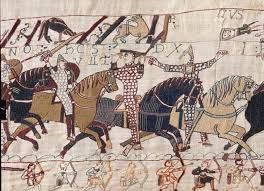
Scenes from the Bayeux Tapestry
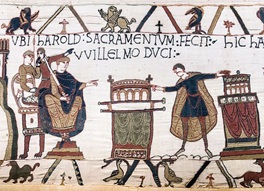
Scenes from the Bayeux Tapestry
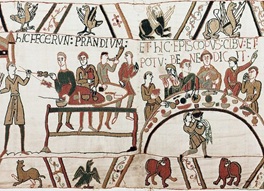
Scenes from the Bayeux Tapestry
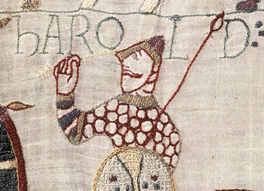
Harold and the Famous Arrow
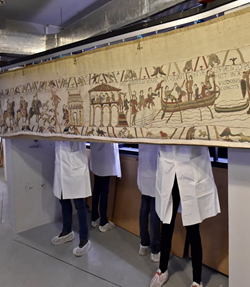
Moving the Bayeux Tapestry (Bayeux Museum)

Clare Hunter
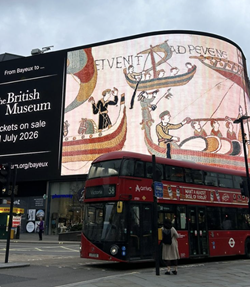
Bayeux Tapestry Tickets go on sale
Script
The Bayeux Tapestry Comes Home After 1000 Years
JA: Not many textiles get an armed guard to accompany them when they are moved in secrecy at the dead of night – but this one is extraordinary in every way – recognised by UNESCO as a Memory of the World – it defines in stitch, an age, a people, a story that even after a thousand years reaches down and touches us all.
In a few days, the Bayeux Tapestry will open to visitors at the British Museum in London. It’s the first time since this extraordinary work of art was stitched probably in Kent, that it has returned to the shores where it was made.
It is in truth a work that belongs equally to France and Britain, a marker of the deeply entwined history of these two nations. It was made at a time of huge upheaval and change, in the wake of battle and conquest. But the story it has to tell is a complex one: commissioned by the victorious Normans, made by defeated Anglo-Saxon women, it was constructed to serve a very particular political purpose.
Welcome to Haptic and Hue’s Tales of Textiles. I’m Jo Andrews, a handweaver interested in what textiles tell us about ourselves and our communities. This episode returns to the Bayeux Tapestry and looks at both the practical labour of making this work of art and also sets it in context: why it was made and what it was supposed to do? We start with the Anglo-Saxon women who made it – they came from families of the defeated – and they faced deep personal uncertainty:
Michael Lewis: We’ve got a group of women essentially that are coming together that might have had quite individual experiences of the Norman Conquest. And those experiences might be quite varied maybe their husbands even got killed in the Battle of Hastings or their, or their sons or other people. And they would be reflecting upon that, I guess, as they were creating this work of art. I think they would’ve had quite interesting conversations, whether it helped them, made sense of it. I, I don’t really know, but it certainly would probably trigger quite a lot of different emotions, I would’ve thought, wouldn’t it? And you know, maybe there was an element where speaking to other people was, was helpful to a degree as well. But I guess that a lot of them would’ve had a similar sort of experience of the Norman Conquest, what had happened to their families, and then maybe their kind of fears or hopes for what the future might bring.
JA: Michael Lewis is a member of the Bayeux Tapestry Scientific Committee and co-author with David Musgrove of a recent book on the Tapestry. As many know the Bayeux Tapestry is not a tapestry at all but an embroidery – it got stuck with its name by a French monk called Bernard de Montfaucon in 1729 when he published engravings of the work and called it a Tapisserie: sadly it stuck and ever since it’s been the Bayeux Tapestry, even though it’s unlikely to have been made in Bayeux. The more or less settled thinking is that it was commissioned by Bishop Odo, half-brother to the victor of the Battle of Hastings, William, Duke of Normandy, the new King of England. Odo was both Bishop of Bayeux and the newly created Duke of Kent. The thought is that the tapestry was stitched in or close to Canterbury in Kent.
Michael: We mostly think nowadays that it was made in Kent at Canterbury. And there’s a, there’s a number of reasons to, think that. One goes back to Odo Bishop of Bayeux being the potential person who commissioned the Bayeux tapestry. He was Earl of Kent, and he had lands there. There are people mentioned in the Bayeux Tapestry who seemed to have a specific connection to him. It’s quite interesting, these sort of arguments around Odo, because if you sort of take him out the equation, then other aspects break down. So, a lot of it is based on the assumption that Odo was behind the Bayeux Tapestry, it definitely has this connection with people in Canterbury, probably most important. But again, it doesn’t necessarily mean that Tapestry was made there. It seems that the Bayeux tapestry designers have been influenced by Canterbury produced manuscript art, or at least manuscript art that was in Canterbury. And so, there’s a suggestion, which I believe, that the Tapestry designer had access to the libraries of both St. Augustine’s and Christchurch at Canterbury or manuscripts based in those. Now, there is another problem with that in that <laugh> in that Canterbury is probably one of the best-preserved archives in terms of the books produced there. So maybe we have a bias in the information that leads us to, to go to Canterbury, but nonetheless, there’s a couple of scenes within the Bayeux Tapestry that almost seem to be directly borrowed from Canterbury manuscripts.
JA: We will never know exactly who the stitchers were or what they thought, but the tapestry they made allows us imaginatively to reach back to them and the age they lived in. The tapestry is stitched on linen and worked in wool dyed with plants. A lot of scholars thought it might have been created by nuns, but Michael Lewis says that at the time embroidery skills were far more widespread.
Michael: But when you look at the historical sources that talk about embroiderers and people doing this sort of work in the late Anglo-Saxon period into the Anglo-Norman period, they talk a lot about aristocratic women, not to say that aristocratic women made the Bayeux Tapestry, but they were certainly doing embroidery and other sorts of textile works. But they also talk about people you know, on an everyday basis, producing garments and materials. And if you look at late Anglo-Saxon society, that makes a lot of sense, doesn’t it, really, that people are making their own clothes. They would probably learn a lot of the techniques that go with that, in terms of embroidery as well. They talk about people making garments for other people, which tend to be high status people. But you could see that that would kind of sink right through the whole strata, really. So, I think the pool of women that potentially could have worked on the Bayeux Tapestry could be quite large in some respects. And some people have said, well, you know, how experienced were they and how expert were they? And a few other things that can potentially be gleaned out, looking at the embroidery work itself and the skill needed to do that. Now, if any of us were plucked out of the <laugh> out there and asked to do a bit of embroidery work, and I’ve done some myself, you’re not very good to start with, are you? But I think it is something that a lot of people could potentially be quite good at with some training and some time. And I think a lot of Anglo-Saxon women would’ve had that naturally in the course of their lives.
JA: There have also been thoughts about the age of the embroiderers:
Michael: Other things people talk about, which I think are really quite interesting is in terms of, you know, how good is your eyesight and what impact does that have on, creating sort of textile works. So, i.e. are these mostly likely to be younger women than older women potentially. Also, what sort of time of the day is best for embroidery, for example, in the winter, is it really a good place to be embroidering inside a house when it could have been quite dark and all you’ve got is the fire. Maybe this is a thing that you would do outside when the light is natural. So, I think there’s kind of quite interesting things here in terms of the mechanics as well as the people that may have produced this. So, in short, I see these as probably what we might call secular people predominantly being brought in to work on this project probably through kind of different sort of local connections based on them having a level of expertise saying that when you look at the Bayeux Tapestry, it’s fairly clear that there are some embroiders who are better than others, probably.
JA: We also don’t know how they were recruited or persuaded to carry out this work.
Michael: What basis were they there, had they been sort of picked out and invited to come and produce this lovely tapestry that was going to tell the history of the Norman Conquest and make everybody feel much better about it all afterwards? Or were they sort of, you know, taken by the cuff and neck to say, right, you’re doing this, get on with it. So, I suppose that might make a slight difference in terms of, you know how they engaged with this project. Maybe they were just grateful of course, that they were getting kind of a good income as well in terms of producing this work.
JA: Clare Hunter has worked as a community stitcher. She is also the author of the much-loved book, Threads of Life, in which she writes about the Bayeux Tapestry. She says that for the women stitchers, there would have been an emotional side to the work but also a physical one.
Clare: They would’ve had an overseer overseeing their work. They were working with difficult materials, you know, wool yarn for those that use it, know it’s actually a very difficult yarn to use because it snags when you work with it, it’s, it’s tricky. It breaks in the needle’s eye. And they were only using four colours. So, there was a very limited palette, they might have had other shades attached to those colours, but only four stitches. And trying to express the whole story of what led up to the Battle of Hastings. And then the ghastly aftermath of the defeat in all those, you know, incredible river of narrative that they made in just those four stitches with their four colours. And so, they had to really think very hard about how to capture, you know, the pounding of a horse’s hoofs. So, all those things were technically difficult. And practically, of course, they’d be sitting for hours and hours and hours over long tables the way they sewed. They would have one hand underneath a frame. The other hand on top, repetitive strain injury must have been something that they experienced. So, I think all that would’ve made it arduous. I think it would’ve been a difficult task. And, of course, it would’ve taken years.
JA: On the other hand, they had the solidarity of sitting together:
Clare: And what I think is interesting is in the Bayeux Tapestry, while we’ve got over 200 horses, over 600 men, over 500 other animals, we actually only have six women. And those six women are depicted as being smaller than any of the other figures in the tapestry. So, it is thought, and I do believe this, that the women inserted those images covertly and basically put in these tiny, small cameos of what their own experience was. And that’s where we get to the kind of emotional sense of what it was like for those women to sew. Because what they were having to revisit was their own trauma in terms of that battle, in terms of defeat and sewing it down, sewing down their own dead and wounded soldiers, their own men folk and sewing their own places that had been decimated. So emotionally, I think it must have been very heart-breaking at times for them to depict what was there. But then as I say, they put in these tiny images, a woman holding the, the hand of her son fleeing from a burning house, another woman being advanced upon by a man with, an erect penis which suggests rape. Different kinds of images that would’ve been dangerous, but which they were determined to put in some evidence of their own personal testimony of what their experience was like. So in that sense, you’ve got this sense of a different kind of camaraderie between the women themselves saying, yes, let’s do that. Let’s put in that image. He won’t see it. The overseer won’t notice it, but at least our story will live on. So you’ve got the emotional heartbreak of what they were pursuing and the emotional defiance of what they were then inserting themselves.
JA: Clare thinks that there are parts of the Bayeux Tapestry that we have probably lost the means to understand:
Clare: So I think particularly in the border, I think the main panel which is the main narrative panel is obviously the story. It’s the illustrations of what actually happened with view people depicted in the borders. However, we have a whole range of other little images of, particularly of which again is interesting of, of fettered creatures, be they birds or of animals, or there’s also trees throughout the whole Bayeux Tapestry. So there’s other little things that if we had the visual language of the time, we would’ve been able to read more into another layer of thought or another layer of emotion. And we can’t really decipher it to that degree. and so in many embroideries, we can’t really decipher the emotional significance of what was sewn because we don’t know the connection. So we understand that a heart stands for love. We understand that a dove stands for peace. And, we do see these symbols in sewing today. But we have forgotten some things. One of my favorite is the fact the bunting you know, triangular loops that we put round at birthday partys etc, basically dates back, you know, century upon century to the what was the jagged triangles that you found on many traditional embroideries, which was to basically suggest the, the, the ragged peaks of a mountain range, a barrier. And it was really dragon’s teeth or the saws edges. And it was really a protective edging ward off evil. And so we still have that in bunting today. But most of us don’t know where that actually came from. But if you look at any traditional form of embroidery in, in any country, it will always have at its edge that little row of triangles.
JA: Michael and others believe the Tapestry was started around 1070 and it was commissioned by Bishop Odo at a time when the Normans still believed that the English would welcome them.
Michael: When William Duke Normandy came over and became King, he believed himself that the English would embrace him. He felt that that was the natural thing that was, was going to happen because he’d been promised in his view the Kingdom of England. And when that didn’t quite happen he uses, these various tactics really to try and bring the Anglo-Saxons inside. Sometimes he befriends them, sometimes he punishes them. And you can see these different activities at play, which obviously happens nowadays in a modern political environment as well.
JA: And Odo’s Tapestry is part of that play – it’s an attempt to tell the story of the Conquest in a balanced way that tries to do justice to both sides, it’s a piece of political storytelling trying to get the conquered to accept their fate.
Michael: I think what’s interesting about the Bayeux Tapestry is the story is not one of Triumphalism really, in a way. It’s clear, obviously, what happens in the Bayeux Tapestry. It’s not kind of mixing its words, you know, it kind of shows the Normans beating Harold at the Battle of Hastings and the events leading up to that sort of result happening, if you like. But there are things in the tapestry which are much more balanced, I think, when you look at some of the other sources. So, if you read, the typical Norman sources, they’re really, really championing William in particular and the Normans in general at the expense of the Anglo-Saxons. And you don’t really get that in the Bayeux Tapestry in quite the same sort of way. It’s a bit more of a balanced account, I think of those, those years.
JA: But the problem for Bishop Odo was that about the time he commissioned his tapestry William realised that his softly, softly approach doesn’t work and to survive he has to be much tougher.
Michael: But then he sort of snaps and he is had enough of these Anglo-Saxons, and from about the late 1060s, early 1070s, His regime is, is more of one of oppression rather than trying to, to work with the, the Anglo-Saxons. I suppose what’s really important about this period is, is there’s an assumption that William came over you know, beat Harold at the Battle of Hastings became crowned King at Christmas Day, 1066, and everybody just said, okay, thanks very much. We’ve got a new king. Let’s just kind of relax now. But that’s exactly not what happened. There was kind of rebellions, you know, all through pretty much William’s reign, some of them very destabilizing. And now of course we know that, you know, that William was able to, to keep the crown on, it was passed onto his sons and, and, and, and, and onwards. But that wasn’t, I don’t think, any means certain in 1066 or 1070s when the Bayeux Tapestry potentially could have been made.
JA: And that left Bishop Odo with a problem – one that is ultimately vital to the survival of the Tapestry:
Michael: It’s kind of interesting that you’ve got the Bayeux Tapestry being, being produced with a more nuanced and balanced version of history in a period where that sort of goes out the window. And, you know, Odo is basically told, well, this doesn’t really work with the new political reality. So, you can’t really use it in the way you thought. So perhaps it could have been, you know, while Odo was establishing himself in Kent and the Normans were establishing themselves throughout the country that this object would’ve been taught to, to various places, and somebody would’ve presented in front of it and said, well, this is what happened. And Harold wasn’t that bad, but, you know, you’ve got William now. And that all just didn’t really work later in as we went into the 10 seventies. So Odo is sort of left with this thing to think, well, what do I do with it? And that’s probably why it gets presented to Bayeux Cathedral. Then it may be changed from something that had a purpose to something that is more like a gift, I guess that kind of recounts, if you like his life in, in terms of the Norman Conquest. That’s my kind of working theory at the moment in terms of the, the purpose of the Bayeux Tapestry.
JA: So Bishop Odo needed to find a new role for his magnificent embroidery, and it is this that was vital in ensuring that the Tapestry survived:
Michael: He creates a new purpose, He is obviously a bishop of Bayeux. The new Cathedral is being consecrated and, he’s got this thing that basically says how great he was in terms of helping with the Norman Conquest of England, sort of makes sense to present it to the Cathedral. I think what’s interesting is why the Bayeux Tapestry sort of survives, I suppose. And that again explains that really. I guess if you had an object that was touring all over the place, then it is gonna get gradually get damaged. And obviously, although the tapestry has, you know, a lot of damage to it, it’s in pretty good condition given it’s, a thousand years old.
JA: If it had stayed in England and been pressed into play as part of the political advertising campaign for the new Norman regime then it would have toured up and down the land in towns and villages, being rolled and unrolled as people told the story over and over again. It would have disintegrated slowly as it went, until no doubt it would have been damaged beyond repair, like the vast majority of textiles.
Michael: And it seems to me that it was basically holed up in the Cathedral Treasury. We know it was there in the 14th century for certain, and it seems that it was, probably only taken out on very very limited occasions really. And that probably protected it because it was almost essentially forgotten about to a large degree you until the modern day. And that’s obviously one of the challenges, isn’t it, to know how typical the Bayeux Tapestry is of other sorts of things that were produced at the time. I guess it would’ve been a bit different, but no doubt, maybe lots of buildings would’ve used fabrics like this, not only to decorate the walls, but also to provide insulation to a degree in those places as well. So I, I kind of feel that there would’ve been more embroideries and tapestries and such like, maybe not on quite the size and the scale of the Bayeux tapestry but still they would’ve been quite common things, more common than we probably assume. I guess.
JA: It’s one of the tantatalizing questions left to us – not that the Bayeux Tapestry survives but that there were many other works like it, but that these were not lucky enough to survive.
Michael: Well, there are parts of different embroideries. Some people link to some of those Scandinavian textiles that tend to be a bit later, like 12th, 13th century, which seem to have similarities to the Bayeux tapestry. So sometimes people look at the religious specimens that are associated with St Cuthberts from Durham, for example that are very famous, but they obviously are religious, but they are embroideries, and significant textiles as well. There’s also actually a poem that was written that’s almost contemporary with the Bayeux Tapestry that mentions something like the Bayeux Tapestry in the Bedchamber of William, the Conqueror’s daughter Adela. And that talks about a tapestry that tells the story of the Norman Conquest of England but it has gold threads within it as well. There’s lots of different theories about that. But it, in essence, it kind of gives an impression that there were other things like this, in the material culture that people had and owned.
JA: But the Bayeux Tapestry does survive and for centuries it has exerted an enormous power over our imaginations. It has for the most part lived a quiet life in Bayeux interrupted by some terrifying moments. It was nearly destroyed in the French Revolution – it was destined to be cut up for wagon covers. Then Napoleon took it to Paris to inspire his troops before his planned invasion of Britain. Later in the 20th century Hitler also had it taken to Paris with the intention of removing it to Germany.
Michael: It’s difficult to know whether that appealed to Hitler and Napoleon in quite the same way as it does now, <laugh> to us. But certainly, for us it’s, the cartoon nature of the design makes it seem very sort of familiar. It’s, it’s almost a genre that we are kind of feel quite comfortable with. I know it’s got words and letters on it, and, that helps tell the tale, but in some ways, you don’t actually have to be able to read to understand roughly what’s going on in the tapestry. As long as you have a basic understanding of the history and what went on, you can start to identify people. One thing I like about the tapestry as well is it’s almost like you kind of meet people when you have these historical creation films they’re like dramas, and you don’t know what these characters are like. And then in a, you know, an actor will play this character and you think, oh gosh, I know exactly what Alfred the Great’s like now, or whoever, because you see them in a play. And I think the Tapestry does the same sort of thing. You kind of start to say, oh yes, that’s what Williams’s like, and that’s what he sort of does. So, I think there’s something about it that sort of draws you in, that makes this history that you may have heard or you may have read about, you know, come to life, you know, visually. Because, you know, immediately you can say, oh yes, this is, this is Harold on his throne, or this is this is what Edward the Confessor looked like, or this is what the Normans looked like.
JA: Michael believes the Tapestry has an immediacy about it that means it gets used over and over again for political purposes:
Newspapers particularly, you know, with Britain’s relationship with Europe, but specifically with France, you get these kind of cartoons, that present the English versus the others, and it’s them and us type thing that kind of comes through those, those sorts of cartoons. But obviously, you know, those newspapers are used to printing political cartoons. So the tapestry is almost, straight in there as a, an automatic go-to, you don’t have to think too much, you’re just trying to change the looks of some of the characters, don’t you? So I think, politically obviously for Hitler and for Napoleon, I mean, they were coming at it from slightly different angles, of course, but essentially it does show that it was possible to, to take England by storm and conquer the whole country. And of course, that’s what Napoleon was hoping to happen when he displayed the tapestry in Paris, you know, as inspiration to his troops before they embarked on their journey across the channel, which obviously never happened. And likewise you know, Hitler was quite interested in the tapestry, not only from that perspective, that , the Anglo-Saxons or the English could be beaten but also from the perspective of identifying with the Normans and the, the subsequent Vikings as a kind of race that’s connected to the success, if you like, of the Germanic people, the fact that you can have these warrior elite that then take over, over, over countries or other places obviously fitted in well with what their logic was.
JA: But for Michael much of the power of the Tapestry lies in who it depicts:
Michael: So something that tells a story in a narrative way that is not only the history of the kings and queens, but also shows individual people. Because obviously in the tapestry, we have these moments where a woman and a child flee from their house because it’s being burnt down. And you have this dialogue between people that don’t seem to be quite the aristocrats in society and, you know, there’s things going on in the border that are quite intriguing as well. So yeah, I think altogether it just means that it, it provides a very useful way of interrogating this sort of period of history, which otherwise would seem super remote, wouldn’t it?
JA: The Tapestry seems as alive and powerful today as it did all those years ago when new rulers arrived in England and commanded its creation by those who had been defeated. But its fame has grown considerably during even my lifetime. I first saw the Tapestry as a child when my parents took me to in a VW camper van to northern France in the 1960s. In those days it was displayed very simply in wooden and glass cases in a re-purposed building in Bayeux. There was no great excitement about it, there were no coaches and no queues, we paid a minimal fee to see it, you could stay and stare as long as you liked, alongside the other odd British tourist who happened to be passing through. There were postcards to buy and a book or two in French but not much else, even though it was the around the 900th anniversary of the battle. I knew it was an incredible work even as a nine year old and it made a deep impression on me. But now in its new age of global fame, it still has new things to tell us and it is more than a remarkable survivor of a dead age, it is a part of living tradition of expression and artistry with a needle and thread that continues to thrive: Here’s Clare Hunter.
Clare: There’s a lot of quirky, witty ways that people are using needle and thread to then add their protest to events. And also I think that in terms of textile art, there’s an explosion of incredible work being done by not just women, but men artists as well, using textiles as a way to express their voice and legacy of history in an, in a different way. Which is, is showing sewing not just as something that is decorative, but something that has always carried meaning, meaning and potency. So, I think there’s a lot of that going on. And I think that in this kind of algorithmic world of ours, people are spurning the idea that they are just a known quantity and turning two things that are individual, personalized and special in order to keep hold of their own sense of private and to say individual cells. So I think there’s, all these things are happening at the moment and I don’t think Stitch is going to go away any day soon yet.
JA: Thank you for listening to this episode, and thanks in particular to Michael Lewis and Clare Hunter. If you would like to see images of the Tapestry on its journey to London, or read a transcript of this podcast you will find these resources at www.hapticandhue.com/listen.
Haptic and Hue is hosted by me Jo Andrews. It is edited and produced by Bill Taylor and sound edited by Charles Lomas of Darkroom Productions. It is an independent podcast free of ads and sponsorship, supported entirely by its listeners, who generously fund us through Buy Me a Coffee or by becoming a Friend of Haptic & Hue.
In this month’s Travels with Textiles on Friends of Haptic and Hue – which goes out in two weeks’ time we will be exploring the incredible story of the 400 year old dress in near perfect condition that was found under the sea off the island of Texel in The Netherlands. We will also have brand new gifts for a September draw for our Friends. If you would like to know more about Friends then go to www.hapticandhue.com/join But until then its goodbye from me and enjoy whatever you are making.