

Episode #72
Jo Andrews
In Britain, the Canadian wartime quilts were often loved and cherished. But gradually, as the years passed they faded from memory. A few hundred have survived and many museums in the UK hold them. In Canada they were completely forgotten. Now it is hoped that with the return of this major collection a new generation will come to understand the work of their grandmothers and great grandmothers. The aim is that there will be a permanent exhibit of the entire collection to stand as a memorial, not just to the women of Canada, but to all those around the world who use their textile skills in times of conflict to bring comfort, compassion and care.
Notes
Joanna Dememenjian can be found on Instagram as https://www.instagram.com/suture_and_selvedge/ and there is a Facebook group about the quilts called Canadian Wartime Quilts, where you can see some wonderful pictures of the wartime quilting groups in Canada: https://www.facebook.com/groups/2151817721613035
Most of the funds to get the quilts back to Canada have been raised, but if you would like to contribute to the final amount the link is below.
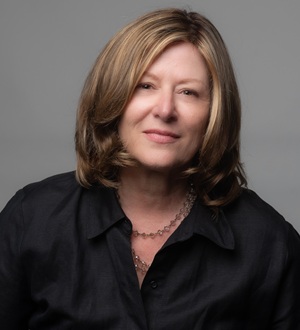
Joanna Dermenjian
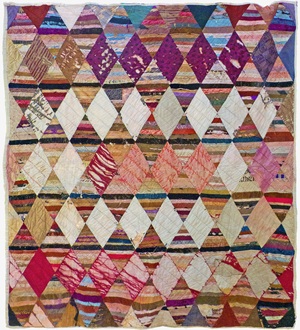
Quilt collected in Dumfries, from the Anna Mansi Collection
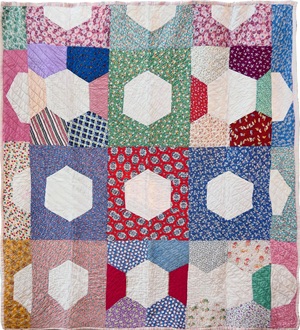
Quilt collected in Selsdon from the Anna Mansi Collection
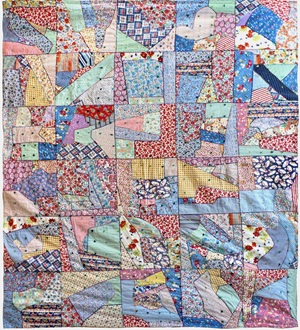
Quilt collected by Jan Hassard and then collected by Anna Mansi
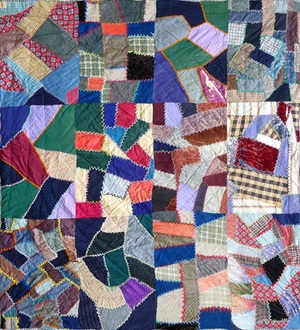
Quilt Collected in Berkshire as part of the Anna Mansi Collection
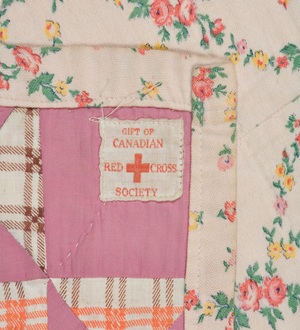
Typical Label on a Canadian Wartime Quilt
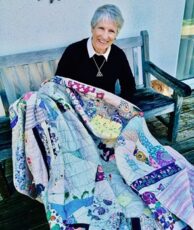
Jo and the Canadian Wartime Quilt She and Her Mother Found
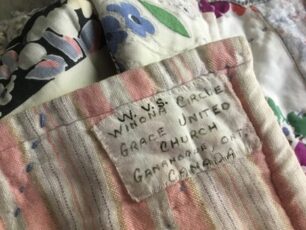
The Label on the Back of Jo’s Quilt
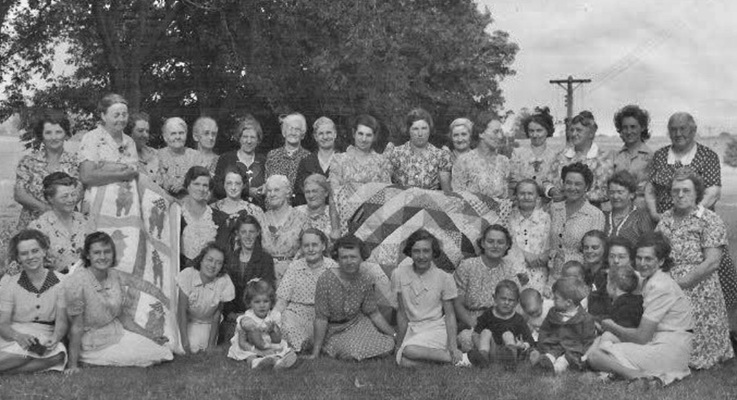
Canadian Wartime Quilters, West Arran, Ontario
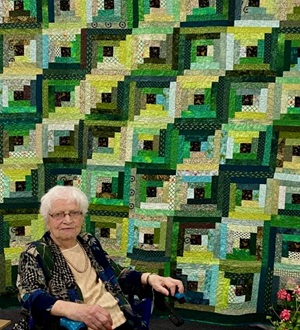
Phyllis Van Horn with her Last Quilt – Called The Last Hurrah
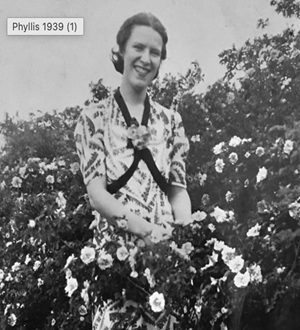
Phyllis as a Young Wartime Quilter
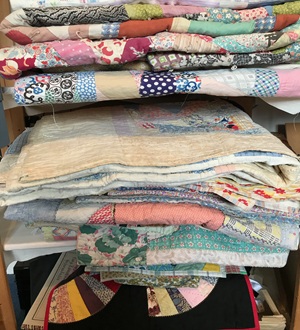
The Quilts Collected by Maxine March
Script
The Return of Canada’s Forgotten Wartime Quilts
JA: Textiles are memory and care, comfort and consolation. In this tale they have been all these things and more, but as the years have passed – just as the fabrics themselves have altered with age and use, the story of how they are seen has changed and is still changing, even now. These past few weeks a collection of very special quilts has been arriving in Canada – they are being returned home to the country where they were made as the last memories of an extraordinary effort by Canadian women and children to help the victims of the Second World War.
Welcome to Haptic and Hue’s Tales of Textiles, I’m Jo Andrews, a handweaver interested in the stories textiles tell us. This month’s tale is one that we first looked at five years ago but, even in that time, as we will see, the story of these magical quilts has developed a good deal. 85 years ago, at the start of the Second World War the women and children of Canada embarked on a project to comfort the victims of the conflict. They started to make quilts, entirely voluntarily. These were shipped to Britain and given away to those who were bombed out of their homes in the Blitz, to orphans who had lost their parents, to land girls in hostels far from home, to soldiers convalescing, to refugees, returning prisoners of war and many more in desperate circumstances during and after the Second World War.
Over 400,000 quilts were made and very few who those who put their labour into them ever knew what happened to them. In Britain many of the quilts became deeply loved – not just as temporary stop-gaps but as ingrained parts of family life. As the years passed the quilts became worn and tattered and often simply fell to pieces, carrying all the memories and emotions of war and what had come after.
In the early years of this century three determined women, Maxine March, Jackie Maxwell and Anni Mansi set up an organisation in the UK to rescue and register the last surviving quilts and to tell their stories. They collected and identified a few hundred. Museums and institutions in Britain were offered their pick of the quilts and there are many in the UK that can be seen and studied.
But what to do with the remainder? In 2024 over 60 quilts were returned by Maxine March and Jackie Maxwell to different museums across Canada so that the story of how they were made could be told in every community that had contributed. Now Anni Mansi’s collection of more than 40 quilts, is also being returned to Canada by her husband Tony. They are coming home to a country that knows significantly less about them than Britain. For many years it was as though they had been wiped from national memory, Joanna Dermenjian, who researches these quilts, says there are good reasons for that.
Joanna Dermenjian: Why are these quilts not well known in Canada, but are in Britain? And so when we think about World War II geographically in Canada, we experienced war in a very different way. So, though we declared war on Germany just a week after Britain, and it was a daily thing in our lives for that period of time for the Brits, it was on your soil. It was in your sky and sea and land happening all around you. And people were dying. Your neighbours even were dying, not just those who enlisted. And for Canadians war existed on the radio and in letters and newspapers and government speeches, and it was a constant, but it wasn’t as visceral for us. And we, we were not the leaders of the war. We were in support of Britain. Then the war’s over: 1.1 million Canadians enlisted in the war out of about 11 million, so roughly 10%, huge number population, 45,000 killed, 55,000 wounded, 10,000 POWs. And so the focus of our nation went from supporting the British to remembrance of our own contributions in those who were killed and wounded and still suffering and needed rehabilitation. And rightly so, this was happening to in every nation. But we turned inward on our own nations to, to care. And we were looking at memorials. We were looking at renewal, cultural change, economic shifts. And so the unpaid work done by women during the war, and in particular in textiles, that was, that was what women did anyway, right? That was usual work for women. Sewing and knitting. It was usual. They sew and knit every day of their lives generally. They were just producing it at a frenzied rate during the war. But remembering and honouring and aiding the veterans took precedence over recording and documenting the work of women that was finished and over.
JA: Joanna believes that there is something universal in the way in which the women of Canada created textiles during the Second World War.
Joanna: But here we are 80 years plus later. And well, one thing that we know for sure is there has not been a war to end all wars, as was hoped, <laugh>. And there’s conflict everywhere based on religion or geography or economic survival. And women continue to be tasked with or accept the role of, or initiate the role of care. And when I think about the opposite of war, I don’t think it’s peace. I think it’s care. And that care is on the continuum. If you are going to be destructive and violent and create conflict, you, there has to be clean up, there has to be healing, there has to be care. It has to come with, it has to be existing at the same time, and it has to come afterwards. this is what the women of Canada were working on at that time. They were working on care, and women around the world were contributing to that care. And they stitched and they stitched and they stitched. That was the agency they had. That’s all the agency they had. I don’t know what else I can do. I can write letters and I can stitch, and they knit and sewed and knit and sewed and packed and sent. And then they went on with their ordinary days and their ordinary lives, and did the usual after the war. And so what they, the work that they had done was forgotten and assumed. But in Britain and Europe, those quilts survived, and they continued there to tell a story that we didn’t know here.
JA: Tony Mansi who is donating this collection and Joanna both believe it is important that the Anna Mansi collection of quilts are held together, and as such they offer something more than just seeing one or even two quilts on their own in isolation.
Joanna: And what I believe the challenge is in understanding this story is having a collection, having more than one in a museum or two, that it doesn’t set a basis for us to actually have a conversation about them. We want to see more than three at a time to begin to understand the context of the work that was done and to understand the vast production, not only of quilts, but of all the textiles that women were making during the war for the war effort. The way that I view these quilts, I look at them in the context of all of the work that was done by women during wartime and not just Canadian women. it’s women in Britain, it’s women in Europe, it’s women in Australia, and all around the world that women are doing all the time in places of conflict. But in speaking of the Second World War, all of the other items that were made, the socks that were knitted and the sheets and pillowcases and pajamas and sweaters that were knit, all of those items were consumed and in a sense used up, and I sort of imagine our compost now in, in their existence. But these quilts that are left are like rising up like sunshine to tell a story They are artefacts that carry a story of a much broader history of women’s work, of textile work, of war, of care, of compassion, of patriotism.
JA: Joanna will get these all these quilts back to Canada if she can finish raising the funds to do this and to hold them as a collection. I’ll post a link to the funding page on the website at the end if you would like to contribute. What follows is the original story made five years ago about the quilts, you will find out why this has a very personal resonance for me. I should warn you that one person you hear in this – Phyllis van Horn is sadly no longer with us. Phyllis was one of the last surviving wartime quilters and she died in 2024 at the remarkable age of 102.
My part in this story started 30 years ago – one cold winters morning when I was helping my mother collect blankets to send to the Kurds in Iraq. They had fled into the freezing mountains to escape Saddam Hussein’s murderous army. Blankets was the least we could do for them. At the end of the morning we sorted through the donations and found a quilt, an old hand-made quilt with a striped cotton backing. It had a handwritten label that said: WVS, Winona Circle, Grace United Church, Gananoque, Ontario, Canada. The fabrics that made up the front of the quilt were 20th century, probably, to our inexpert eye from the 1930s or 40s. I have no idea to this day if we did the right thing, but, we made a donation to the Kurdish Relief Fund and kept the quilt. We never saw who gave it in and we will never know what their motivation was in doing so.
It is a joyful thing and very much of its time. The quilt was made from what looks like dress fabrics shaped into different square blocks, any which way, so that no piece of fabric was wasted. It was then hand quilted with blue thread and a pink and blue backing fitted to it. It was made for a single bed, and, even though it is composed of many materials it works – it looks as though it belongs as a single piece.
For many years we could find out absolutely nothing. It was a puzzle. My mother tried ringing the Grace United Church in Ganonoque – they told us that they knew nothing about a quilt or the Winona Circle.
And then in 2010 the Victoria and Albert Museum held its memorable Quilt show. In amongst all the grand and the great quilts was a much humbler one that said: Bedcover: Maker Unknown, Canada: This quilt was made by the Canadian Red Cross Society as part of its initiative to provide relief for civilian victims of the Second World War. It was clearly a relation of our quilt, so now we had an idea that ours was a Canadian Wartime Quilt.
More years passed and then late last year, I got an e-mail out of the blue from Joanna Demenjian in Canada asking to be considered for one of the free gifts Haptic and Hue gives away with each episode to subscribers to the newsletter. Joanna signed her e-mail with the strap line: Researching Canadian World War 2 Red Cross Quilts, and guess what her postal address said? Gananoque. I couldn’t believe my eyes.
Joanna had started researching Canadian Red Cross quilts while working on her Masters Degree looking into women’s practice of stitching for leisure:
Joanna: And so my, my supervisor asked me to find one artifact that I could centre my research around in order to talk about this. And somehow on the internet, I found a red cross quilt. It popped up, I think, on my Pinterest feed and I read a little bit about it on the Red Cross website the Canadian Red Cross website. And I was really intrigued by this little label and the, the description said that these quilts were made by women in Canada during world war II. So I just started to look for more information about them. And I, I was just, I, I was so surprised I couldn’t find any, I, there were brief mentions in, in Canadian quilt books but not in journals. And I was quite new to the whole idea of researching in primary sources. So I talked to the librarians and, you know, went through what I was looking for and, and she she agreed with me just as she did sort of some precursor research. She couldn’t find anything written about these quilts either. So it, I chose this as my topic because I was very interested in getting this story told and getting an understanding of what the story really was.
JA: What Joanna uncovered astonished her. During the Second World War, 55 million items went from Canada to Britain. These items were called comforts and most of them were made by the women and children of Canada.
Joanna: There’s a long list of items that they made. They were, they were sewing for the hospitals. They made sheets and bandages, pyjamas and slippers and robes. They even made cloth face masks for surgeons. And then we know that they were also sewing for the people of Britain who lost everything in bombing. And they were the Red Cross supplied patterns for sewing like jump and skirts and all kinds of different basic items that people would need. I even found an article. This was so sweet that they were the Red Cross asked that women not used very bright colours in the clothing that they were sewing for the people of Britain, because the people of Britain didn’t quite like them to be so so bright <laugh>, isn’t that cute?
JA Amongst this multitude of items were more than 400,000 quilts which were handmade by women and children in Canada. This seems to have been suggested by the Canadians themselves and it looks as though they wrote to Queen Elizabeth – later the Queen Mother – to ask her permission to send the quilts. Permission was granted and every conceivable kind of organisation across Canada got involved.
Joanna: What I have found is that they were made by groups of women but many different kinds of women’s groups. So in Canada, there’s the women’s institutes, which is primarily a rural based community group. The Imperial Order of the Daughters of the Empire is another group of that time that was very popular and very active. But they were also being made in churches and in Jewish synagogues, they were being made in homes. They were being made in Red Cross work rooms which formed a, there were some red cross work rooms before the war, but during the war, they increased exponentially and they would be formed in libraries and other community buildings where women could meet regularly to, to be making even found a red cross workroom at Queens University in the very building where I was taking some of my courses. There had been a Red Cross workroom and female students were making quilt blocks around 1942 and 43. There’s a picture in one of the yearbooks of young female students working on quilt blocks.
JA: And there are pictures too of school children working on quilts in remote rural schools in Canada. Every quilt was different and each quilting group found its own materials, although later the Red Cross supplied the batting and the backing cloth. Joanna has done a quick calculation of the time that went in to make the quilts:
Joanna: I ran some rough numbers to say that even if a quilt is constructed by machine. So if the quilt top is made by a machine, but then the quilting is done by hand, there’s still about 50 hours that would be invested in, in making a quilt 50 hours, women, hours of work to complete a quilt. And the women made over 400,000 quilts in a six year period. It is 20 million women hours of work at minimum to just to make quilts.
JA: Most of the women who were involved in this effort have long since left us – In Canada the time, skill and the craft they put into this work has been almost forgotten – but not quite.
In 1942 Phyllis Van Horn was a young bride, she had just moved with her new husband to Wooler, near Trenton in Ontario. Her husband worked at the Airforce base there and she found herself with time on her hands, until the local church group found out that she could sew. Phyllis is now close to a 100, but her recollection of those years is clear:
Phyllis van Horn: Well, I just remembered how we used to spend the days quilting. There’d be the neighbour women of the neighbourhood, three or four women would get together and quilt for the afternoon. There was no fancy quilting about it. It was all plain, straight going mm-hmm <affirmative> quilting. You would be maybe meet two hours every afternoon or early evening, depending on how much daylight there was, because there was no lights at that time. No electricity. I had no family and it was a good way to get acquainted with the other women. And I had a big living room and they used to, the women would set the quilt up in my, in my living room.
JA: Phyllis still has all the old quilting frames from her mother, her grandmothers and her neighbours stored above her kitchen – every one of them is slightly different. In the war the quilters would often source offcuts from local shirt and pyjama factories, and from suiting and military uniform factories and make them into patchwork blocks, carefully making use of every single scrap.
Phyllis: I thought it was an obligation might as well. Why sit doing nothing. You might as well be quilting. That was your war effort. Everybody did what they could do. Hmm. It was the only sociable thing there was. Yeah. Yeah. They weren’t having afternoon teas or anything like that. They were busy making use of every second.
JA: To begin with Phyllis says she wasn’t very good at hand quilting – but she quickly became skilled at doing it deftly and evenly. And at the same time as being a communal activity, it was also a good way of deflecting anxiety:
Phyllis: Well, I was always scared that my husband was going be posted overseas. Mm-Hmm. I mean, that was the first thing you thought of, you know, Airmen there were airmen everywhere, you know, because we lived at Wooler and Trenton was the main airplane, airport, lots of airplanes all day long in the air.
JA: And that sense of anxiety and unease seems to have hung over many Canadians during a war in which so many of them were directly involved. Phyllis herself likened it to the sense of anxiety she felt at the start of the COVID epidemic and Joanna believes that quite apart from meeting the needs of people at war in Europe the quilters also benefitted from their own work.
Joanna: Well, I think there are, there are two different things that I’m looking at is women. There was a benefit to the women individually, and there was a benefit to the women in the group setting. So we know that stitching by hand is a repetitive and can be very meditate activity, which is soothing to our spirits. But I believe that the gathering together in the community meeting together provided another layer. Another element to this, where women could meet with each other talk about their weak, talk about what was going on, share tips, help each other learn stitching. We, we, we see in some of the quilts, the stitching isn’t done very well, but there weren’t sort of judges saying how many stitches per inch. So, I, my sense is that the gathering together would’ve been encouraging, Phyllis told me that she enjoyed meeting once or twice a week with this group of women who were sewing, because it gave her something to look forward to and a time to be together.
JA: The quilts and all the other comforts went to the Canadian Red Cross who bundled them up and sent them largely to Britain where they were distributed mainly by the Women’s Voluntary Service and the Women’s Institutes – in another story that has not been properly documented – to people in need: people like Jan Hassard who was a six month old baby when she was bombed out of her house in Purley south of London.
Jan: So we lived in a typical semi- detached suburban road. Okay. 13 miles from London and they heard the bomb coming over. So it was half past six in the morning. I, everybody was in bed, but I was in the front room. So therefore I, my cot was under a window. So my mother rushed in, took me out of the cot, took me into the back bedroom with her. And the window shattered when the bomb dropped obviously and fell into my cot. So that was a very lucky escape. And, but they didn’t have time to get downstairs. Cause you had two, I dunno if you know about flying bombs, but you had two minutes. So what happened is the bomb came over. They had it, they must have been up. They heard it coming. The engine cut out. They knew it was near, but they didn’t know obviously where it was going. Nobody knew where it was going to fall. They didn’t have time to go downstairs because they didn’t have a a shelter. So they used to go under the stairs. Sounds a bit bizarre, but it, that was what you did. So she was in bed and I know the wardrobe fell on her and she sort of put me underneath her. I mean, this is all a bit personal, but I am trying to give you a picture of, of what I understand and happened. But obviously she wasn’t badly injured, but the bomb felt across the road. So you imagine a suburban road with all these semi detached houses and a hotel across literally across the road slightly to one side. Anyway, so we were taken to a centre at a church called St. Barnabus. So there was obviously a special centre there that people were taken to when they were bombed out. And that is where we were issued with the quilts. It sounds a strange thing to happen. They must have been given other things because they’d had to leave their house. I don’t really know, but all I know is that we could not go back to the house because it was bombed out.
JA: Jan and her family went back to the house in Purley after it had been repaired when the war was over – she remembers the bomb site across the road was dangerous and spooky, and she remembers the quilt stayed on her bed:
Jan: I can’t tell you the size, but it was Dresden Plate. I can remember lying in bed. And obviously the stitching was not brilliant. And I used to pick at these stitches and it was a sort of, I dunno what the wadding was, but it must be some sort of lambs wool, I think. Cause I could pull it out and I can remember doing that <laugh> and it had a cream background and I, I would imagine it was dress fabric. Because every patch would be different. Every one would be different. You see? So people, the thing is it’s true patchwork and it’s true, true utility patchwork because people would’ve cut up their old dresses.
JA: For those of us who aren’t quilters a Dresden plate pattern starts with a central circle and then has wedges around it to form a plate like shape. When Jan was 11 her aunt made her a new bedspread, her room was re-decorated and Jan’s Dresden Plate quilt went to the rag and bone man – one of those people long gone who travelled up and down British streets with a bell shouting “any old rags, any metal”. Mostly we know the people we make things for and they are an expression of our thought and love for them. One of the things that strikes me here is that the Canadian women and children who made so much, never knew who would get what they made or what it meant to them. They weren’t able to put an arm round these people and accompany them in their loss and suffering – but they could offer them comfort through the handwork and the fabric that went into these quilts. In 2005 Maxine March was a member of a quilt group in the UK where she heard a talk about the Canadian Quilts:
Maxine: When you see one and hold one its history is still there somehow. And I was touched the very ordinariness of them. None of them would win a competition in a quilt show, but they were all made clearly with affection. The other thing is I realized that it was an aspect of women’s work in the war that had just never been acknowledged. And the impact that those quilts made on people had never been recognized outside of the people who actually received them to the extent that the Canadian women who made them, we found, didn’t always realize the impact that these things had when they got to the UK.
JA: Maxine and two friends set up a Canadian Red Cross Quilt Research Group and a Register to collect details of as many quilts as they could find and their location. They also began to collect accounts of who got the quilts and what they meant to them. The stories just spill out of Maxine:
Maxine: Of course, the stories come from people who were children at the time, and some of them are quite poignant. You know, there’s the refugee family from the Sudetenland who came over to Britain just before the War broke out who had by the end of the war five children, the fifth one was born just after the war ended. And the mother died within a few weeks. Now the oldest child, a girl of 14 said to her father that she could cope with the three children below her, but she felt she couldn’t take on a newborn baby. So the baby was fostered, but after 11 months was adopted. It handed over at a railway station with a bag containing a change of clothes and red cross quilts, a crib quilt. She still has it. There’s the story of two sisters who shared a bed and had had a quilt given to them because their house had been damaged by bombing. And at night they used to look at the fabrics on the quilts and take it in turns to choose ones that they’d like to have made into a dress. There’s Betty, who was an eight year old living with her Mum in the East End of London. Her father was away on active service. Her house was bombed and her mother was killed, leaving Betty effectively orphaned. She was sent to a Dr. Barnardo’s orphanage in north Wales, and she described how the girls all slept in one dormitory and on each bed, there was a Red Cross quilt. And at night they used to look at the designs on the quilts and make up stories about them. And she says, their stories usually finished with a Knight on a horse coming to rescue them. Do you want anymore? there’s a letter in the junior Red Cross Journal in Canada from a little girl of about 11 who was in an orphanage in Reigate and she’s writing a letter of thanks. She says they had the most exciting day when a great bundle of quilts arrived, enough for one each for every child in the orphanage. And the way they were distributed was that the youngest child was allowed to choose first. And so on up through the ages, the little girl writing the letter was the oldest child. So she had the one that was left and she says in the letter, but it’s lovely. And I still like it. And people tended, I think, to keep them didn’t they. And it, it’s interesting that some of the ones that have come to me have come from the next generation down because they know how much, you know, value their parents put on these quilts.
JA: And even though the time passes the stories still keep coming. Maxine’s group has documented the survival of just 250 quilts, most of them in Britain, some are in institutions, like the Quilters Guild in York and the Victorian and Albert Museum in London, some are in private hands, Maxine and the Research Group never turn away a quilt and Maxine herself has 56 – stored at home. She believes that lots of them didn’t survive because they weren’t put away for best – they got used and used:
Maxine: I had an email some years ago from a man who tells about how his family received quilts during the war. He lived in an area of Devon called Slapton Sands, which was cleared by the military, completely cleared. Everybody moved out, animals were moved off the land because they used the area for training for D-Day. When the families were allowed to go back into their houses, they found that there was a Red Cross quilt on every bed. And he was a child at the time, but he said all his childhood, he slept under his, when he went away to university and took it with him, when he got married, it was used in his home. His children slept under it until the 1970s. By which time Of course it was very faded. So it went into the dog basket. Oh. And when the dog died, the quilt went to the dump. And I think that’s probably what happens a lot. I mean, I’ve had one that was rescued from covering up a tractor engine to keep the frost off.
JA: Not all the quilts went to the UK, Maxine has documented quilts that went in the immediate post war period to The Netherlands, Belgium and France. Maxine also knows that in a separate initiative the Mennonites sent quilts to Germany with the thinking that they would send them where they were needed, irrespective of the politics. And we also know that quilts were made in America too and sent to Britain – although not in the same numbers.
JA: Maxine is also quite clear about why these quilts and the other items that were made by women have been so completely overlooked.
Maxine: I think part of that is because it’s women’s work and women who didn’t have any official status during the war. I mean, you have to remember in London, the Memorial went up to animals in the war before one went up to women in the war, which kind of sums up the general attitude.
JA: And even now in London the memorial to women in war commemorates those women who wore a uniform, In Canada there is a single memorial to the women who died in the Canadian Women’s Army Corps. There is nothing in either nation to commemorate the millions of women who contributed their textile skills and domestic labour in any crisis. To me the story of the quilts and the other comforts is part of the fabric of Canada’s story as a nation – just as much as maple trees, the Mounties and ice hockey, but at the moment it’s a missing chapter: Here’s Joanna
Joanna: And it was as if that anything that was related to domesticity was set aside or tucked away or hidden or not talked about almost like embarrassing to say, oh, and women sewed all through the war, women, sewed women, knit women, crochet women made things all through the war. They were busy, they made 55 million items. We’re, we’re not talking about that because we wanna talk about what women did outside of that, that actually helped them move forward into a more balanced role in our society, which we’re of course still seeking. But somewhere along the way, we’ve sort of tossed aside that actually some of this making might actually be very good for us and could actually play a role in our lives now.
JA: Joanna knows exactly what her grandfather did in World War One – it is all archived and recorded, but her Grandmother’s record is blank – she looked after five children, ran the farm and still made time to gather with her local community to make items for that war – but no-one recorded that. At the start of this episode I said the quilt my mother and I found 30 years ago had an unusual handwritten label on it. The Canadian Red Cross frowned on quilts being ‘signed’. They were supposed to carry an anonymous label that said simply gift of the Canadian Red Cross. But happily, sometimes rules got broken: our quilt said: WVS, Winona Circle, Grace United Church, Gananoque, Ontario, Canada. After I had told Joanna about it she managed to find out more about it in a week than I had done in 3 decades.
Joanna: So I researched what the Winona Circle was, and the members of the church helped me to find reference to this in a history book about the church and the Winona Circle was a missionary auxiliary, and it was named for the pastor’s daughter, Winona Pitcher, and this missionary auxiliary met in the evenings and made items for missions starting around 1910. So they would’ve been working through the First World War as well. And they were also still meeting during the Second World War. We, I also found by reading the Gananoque Reporter which was the community newspaper still in existence and, I think it started around 1860. It was very much a community fixture. And so it was a great resource to track the work that was being done for the Red Cross and for the people of Britain by the community. And they, the Gananoque Reporter reported in it what people were doing or making or giving. So on the front page, it would say so and so donated this much money, this group donated five pairs of socks and so on. And it would list this every week. So I imagine that this was great encouragement for people to be a little bit competitive and go, oh, look what my neighbour gave. I need to <laugh>, let’s see what we’re going to find and give. I, I, I think it’s a, a little bit of fun. I haven’t found that in any other community.
JA: Joanna also found the grandson of one of the women who had been a member of the Grace United Church during the War. Paul Harding is still a member of the Church today and happily his grandmother, Annie Scott was rule breaker too. She discretely pinned her name and address to the quilts her group made and as a result got some letters written back to her. She kept them and her grandson has them still: they are lovely to read: A note from Alice Waldren in London in 1942 says thank you for a knitted rug given to her elderly mother adding: “We lost our house through the raids and then a second home and all our things.” A typewritten letter from Muriel Butterworth, the Area Organiser of the Women’s Voluntary Service in Holmfirth, Yorkshire says: “Thank you very much for the beautiful quilt which reached us yesterday. I wish you could have heard our evacuee’s delighted cry of; “Oh how lovely” when I took it to her and she gleefully put it over a Government blanket on her bed. I told her from whom it had come, and she said: “Fancy thinking of us from so far away as all that.” This Mrs Heel has four children. Her husband is in the RAF overseas. Her house and all her furniture have been completely destroyed.” There is even a letter from Clementine Churchill in Mrs Scott’s collection, which begins: “I am writing to add my personal thanks to those of every man woman and child in these islands for the gifts which you have sent to help us.”
After thirty years of taking care of the quilt that was handed in on that cold winter’s day, deciding what to do next wasn’t difficult. In early November we packed it up and sent it back to Gananoque – around 80 years after it had left there for the UK. We thought it was right that the town should have its own history back so that it could be enjoyed where it was made, – it is a very small thank you for all that labour that meant so much to people in such desperate circumstances.
Joanna: So on November 11th the quilt arrived back to Canada in time for our Remembrance Day. And on November the 11th, we had a small ceremony at the public library where the quilt was received back to the community. The mayor was there and the counsellor and members of the library and members of the community and the church who had been involved in helping me with the research. The quilt is now in the custody of the Thousand Islands History Museum, which is in Gananoque. And they are working through the process of accessioning the quilt, they’re very happy to welcome into their collection.
JA: That was five years ago, since then the remainder of Maxine March and Jackie’s Maxwells rescued quilts have returned to Canada and now the Anna Mansi Collection is following them. I should stress that many of these quilts are still left in the UK – only last week I agreed to give a home in Edinburgh to a very worn child’s quilt which has just turned up. The hope is that, in future, both nations will understand the stories these wonderful textiles have to tell us of generosity and care in times of violence and conflict. It’s a message that remains as alive and vital today as it was 85 years ago.
Thank you for listening to this episode which pays tribute to the work of Joanna Demenjian, Anna and Tony Mansi, Maxine March and Jackie Maxwell for doing so much to rescue the quilts themselves and the stories they carry.
If you would like to see some images of the quilts, contribute to fundraiser for the Anni Mansi Collection or read a transcript of this podcast you will find these resources at www.hapticandhue.com/listen.
Haptic and Hue is hosted by me Jo Andrews. It is edited and produced by Bill Taylor and sound edited by Charles Lomas of Darkroom Productions. It is an independent podcast free of ads and sponsorship, supported entirely by its listeners, who generously fund us through Buy Me a Coffee or by becoming a Friend of Haptic & Hue.
In this month’s Travels with Textiles on Friends of Haptic and Hue – which goes out in two weeks’ time we will be exploring the story of Chinese patchwork and looking at how early human communities made cord, we will also have some very special textile gifts to give away –Viking Age style sewing boxes complete with bone needles and naturally dyed threads. They have been put together by the heritage educator Sally Pointer who you can hear in the next episode of Friends. If you would like to know more about Friends then go to www.hapticandhue.com/join
We will be taking a rest in August but we will be back in September with more Tales of Textiles, until then please enjoy whatever you are making.