

Episode #69
Jo Andrews
We know that fashion dolls were owned by Mary Queen of Scots, and Jane Seymour, wife of Henry the Eighth of England. Elizabeth the First of England was sent a set by the Queen of France. They played an important role in diplomacy amongst the royal houses of Europe and above all they worked hard to cement the role of Paris, and French dress-making, as the world’s style-makers.
Notes
Rebecca can be found at Textile Tours of Paris or on Instagram at textile_tours_of_paris.
Steve Grafe is at Maryhill Museum of Art in Washington State. The Museum is also on Instagram
Sean Byrne can be found on Instagram
Here is the Moschino Spring/Summer 2021 Collection referred to by Steve Grafe: https://www.youtube.com/watch?v=7dpNzuRda0Y
And here is the wonderful Dior collection for Autumn/Winter 2020, referred to by both Steve Grafe and Sean Byrne. It has a lot of shots of the work on the tiny models by the atelier. The skill is astonishing. https://www.youtube.com/watch?v=yxBFwqRbI8c
Clare Hunter’s book Embroidering Her Truth: Mary Queen of Scots and The Language of Power, has a very good chapter on the use of her pandora dolls if you are interested to read more. It is in the Haptic & Hue UK bookshop and the Haptic & Hue US bookshop
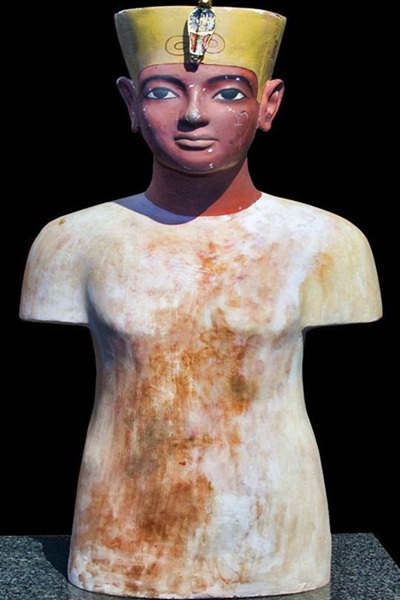
Tutankhamun’s Mannequin: Courtesy of the Egyptian Museum
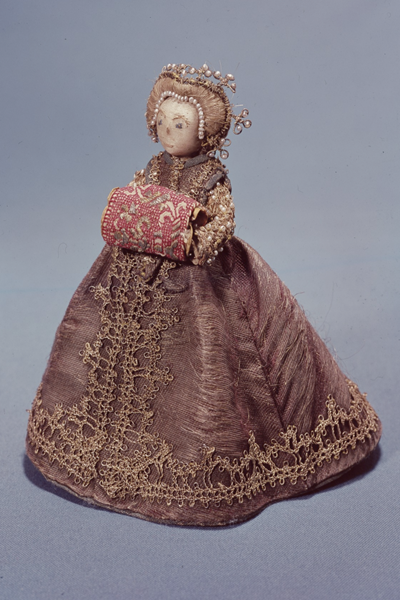
16th Century Pandora Doll: Held in Sweden
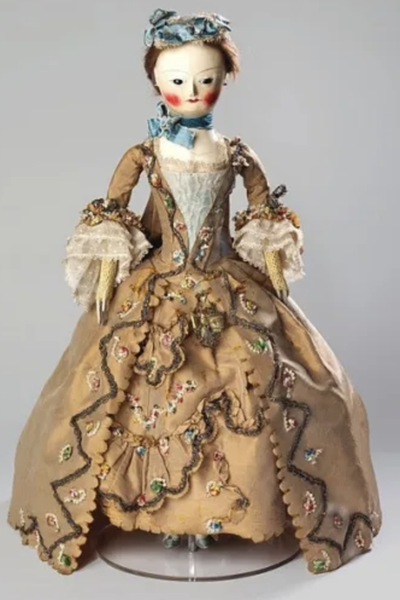
Wooden Pandora Doll: V&A Collection. 18th Century
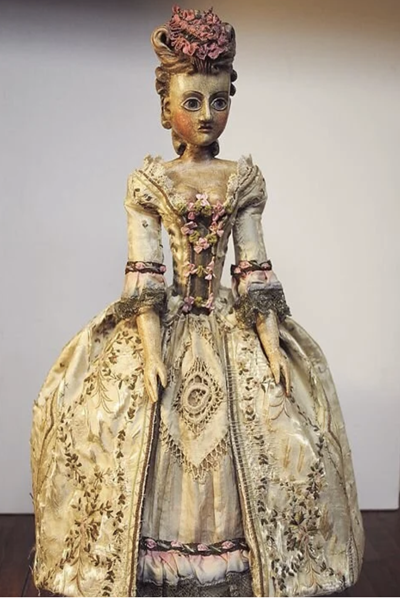
French Court Pandora Doll: 18th Century
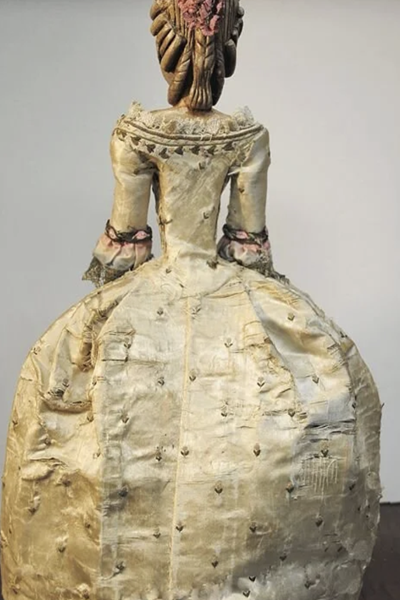
Reverse of French Court Pandora Doll: 18th Century
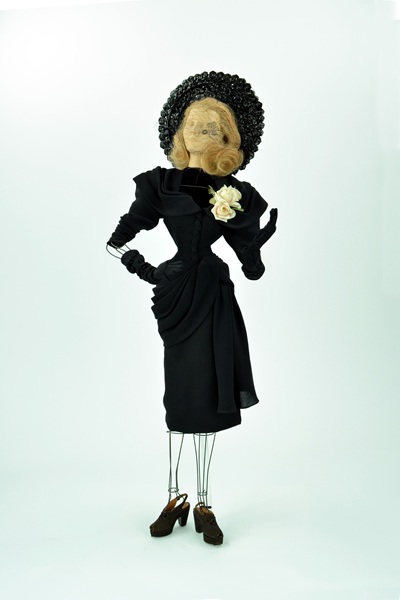
Designed by Nina Ricci 1945: Theatre de La Mode, Maryhill Museum
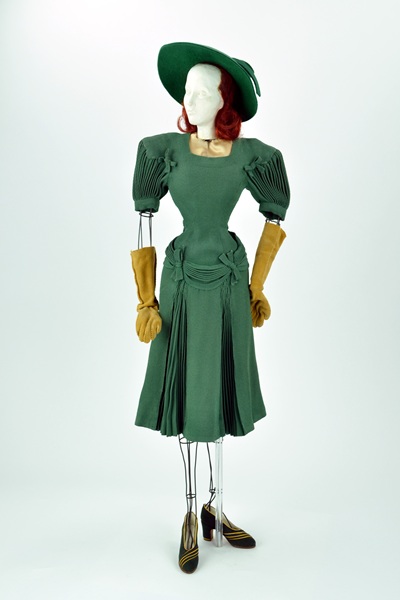
Figure from Theatre de La Mode: designed by Mendel 1946, Maryhill Museum
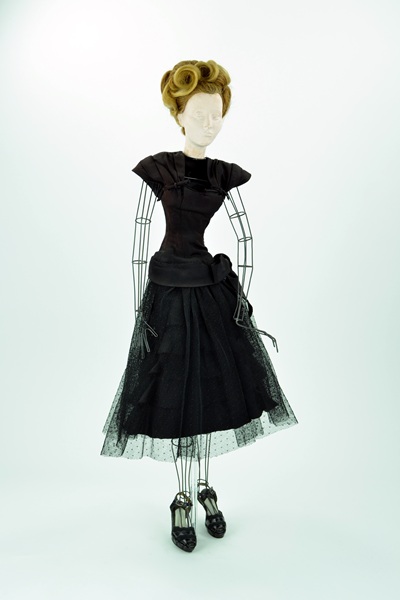
Designed by Agnes Drecoll – 1945, Theatre de La Mode, Maryhill Museum
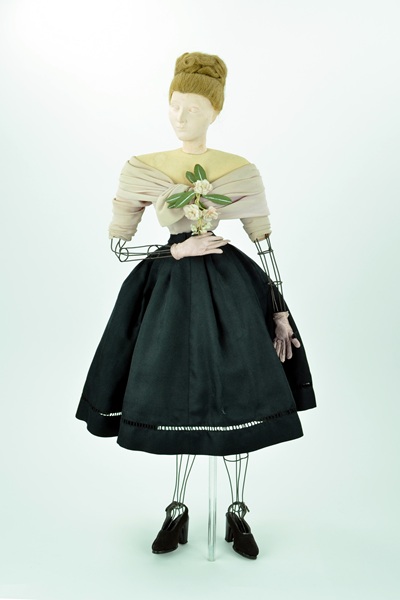
Designed by Lucien Lelong 1945, Theatre de La Mode – Maryhill Museum
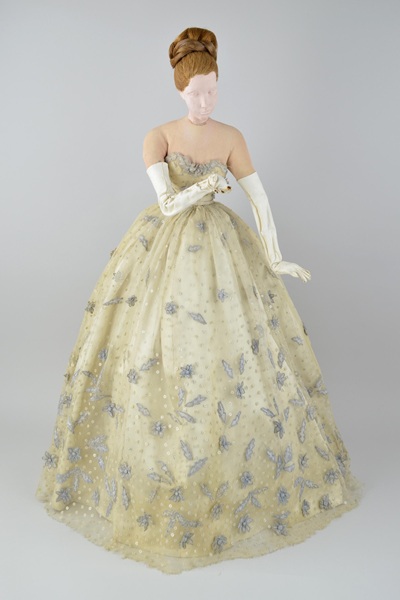
Designed by Lucien Lelong, 1945, Theatre de La Mode, Maryhill Museum
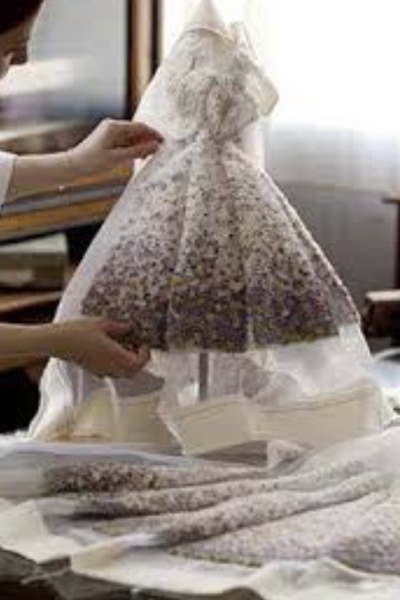
Detail from the 2020/21 Dior Collection
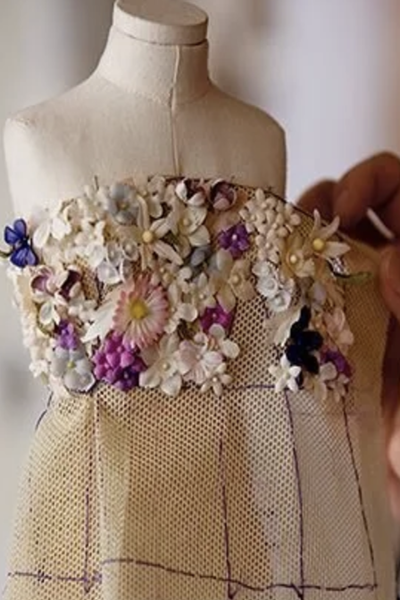
Detail from the Dior Miniature Collection 2020/21
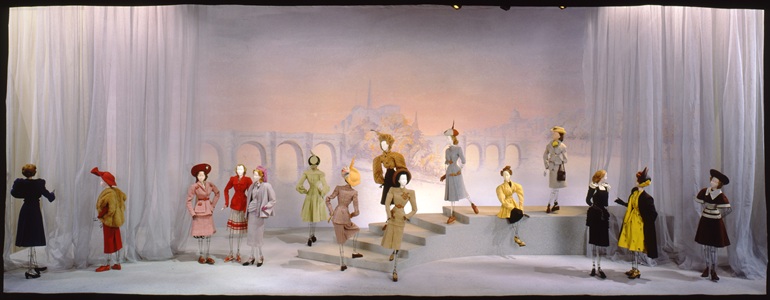
Île de la Cité set for Theatre de La Mode, Maryhill Museum
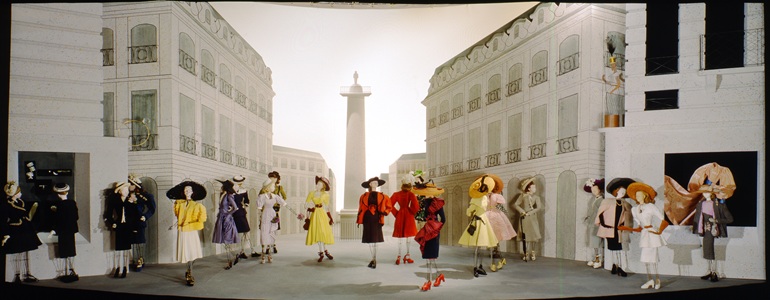
Place Vendôme set for Theatre de la Mode, Maryhill Museum
Script
Fashion and Pandora Dolls: How Style Travelled The World Before Printing and Cameras
JA: Fashion is as old as clothes are, and we know that they go back a very long way indeed. There are some wonderful carved figurines found in Eastern Siberia that seem to be dressed in furs with hoods. They are around 24,000 years old. I’m sure even then there was a right way and a wrong way to wear your fur. But this episode is concerned with times far closer to us. From the Middle Ages right up until the COVID epidemic five years ago, a little mannequin or doll has played a hidden role in history. She has travelled the world in the service of fashion, spreading the word amongst the elite houses of Europe and beyond, playing a part in the politics and diplomacy of the ages, and yet her own life and times have been sadly unremarked. Come with me and listen to the story of the Pandora Doll, who has brokered more than a few marriages in her time. She has seen riots and war. She was plunged to the bottom of Boston Harbour along with the tea and she has survived it all.
Welcome to Haptic and Hue’s Tales of Textiles. I’m Jo Andrews a handweaver interested in what textiles tell us about people’s lives and communities, these are stories that go far beyond the written word. This episode looks at the extraordinary history of the Pandora Doll or Poupine as she was sometimes called. It is hard for us who have instant access to pictures and reels of new trends to imagine what it must have been like before printing and cameras. How did style travel? The answer was these little dolls, as Rebecca Devaney who is an embroiderer who writes and lectures on the history of French Fashion explains.
Rebecca Devaney: These Pandora dolls as we see them, if we’re looking at it through a fashion point of view, yes, they’re very, very important. Before the advent of magazines or fashion illustrations or fashion plates, these little Pandora dolls were used to spread fashion throughout Europe and then across the Atlantic to America, and then throughout the colonies. And they’re just this very interesting, I suppose, method of marketing and communications whereby dressmakers or what they were called here was Marchand de mode. So, fashion merchants would make up dresses in miniature and they would go through very long discussions with their clients about which ribbon to use, which lace to use, which buttons to use, which fabrics to use on which styles overall to use as well. And because at that time, everything was made by hand or made with kind of, you know, the best of materials, they were made in miniature first because it was cost, It was cost-effective. It just wasn’t an option for people to make up a full-size version. And then for the client to say, no, thanks. I want that in blue, or I want that in pink. When, you know, when lace is made by hand you need to make sure that your customer is going to agree with the, that you’re going, that you’re proposing to use.
JA: These dolls had a role not just in carrying fashion but also in helping elite figures dress for ceremonial occasions and modelling how they should behave. It could all be acted out using the dolls in advance. It’s thought that this is how a wooden figure found in Tutankhamen’s tomb close to his clothing chest, may have been used. But it was in France that they really came into their own.
Rebecca: These Pandora dolls it is said that they were used from the Middle Ages and that they had a really important place between the Royal Courts in Europe. So, the Queen of France would send a gift of these dolls to say the Queen of England. And generally, once the dresses were made in miniature by the dressmaker, when the client was happy, the queen or princess or whoever it was, it would be made in life-size. And then once the dresses had been worn in the French court, then those miniature dolls could be sent around the Royal courts of Europe in Germany and Italy and Spain and England and so forth.
JA:: The first written records of these wooden or wax figures date back to the 1300s. French court records show us that in 1321 the French Queen sent fashion mannequins as a gift to the Queen of England, and then again in 1396, the Court Tailor of France, Roger de Varennes made a number of dolls for the Queen of France – Isabel of Bavaria for her six year old daughter – also Isabella – who had been sent to England to be betrothed to the King. The dolls were not for her to play with, instead they were for her tailors to copy the clothing and for her to emphasise her valuable French provenance. We know that Mary Queen of Scots, who was brought up in Paris, had a set of Pandora figures and that she and her ladies in Waiting – the four Mary’s – dressed them in different costumes while they were in Scotland. When we think of Mary Queen of Scots, and her particular grace that comes down the centuries, she is wearing black velvet and white lace. This is how she chose to be painted and how she wished to be seen, and her mannequins played a central role in how she and her ladies in waiting worked that out. Think too of Elizabeth the First of England, red headed, in magnificently embroidered costumes in russet colours, studded with jewels, huge sleeves, lace ruff, and the story of the Pandora mannequins makes you realise that the Royal Courts of Europe used ideas of fashion to project their majesty, to elevate themselves from the people and to help their subjects understand that they were Queens to be served and obeyed, which at that time was a difficult thing for a woman to pull off. The clothing was a central part of their display of power.
Rebecca: It wasn’t just fashion, like at that time fashion and everything that went with it, fabric, lace, ribbon, embroidery all the undergarments and so on, so forth, they were hugely important to the French economy. And I think it was Jean-Baptiste Colbert, the minister of finance in the 17th century declared that fashion is to France what the gold mines of Peru are to Spain. So, they really were highly important, these little dolls, what they were saying to the European ports and then later on to America And then the other colonies was that France was the place to go to buy fashion or to buy what you needed to have your fashions made.
JA: Perhaps because of their association with royalty, the little figures always seemed exclusive and desirable. Their heyday came in the 18th and early 19th century, as transport improved, aristocratic courts across Europe multiplied and tailors round the world began to order their own transportable mannequins to showcase their wares. Men and women became fascinated by fashion for the first time, and especially in England, far larger numbers could afford it as a prosperous mercantile class emerged. This was the start of the fashion retail market. Every detail was perfectly made for the miniature mannequins, from the underwear to his or her hair and hats.
Rebecca: Your hair style was extremely important and hair like your coiffe or your coiffure was made of a huge amount of, you know, there’s a lot of artifice went into it. It wasn’t all your own hair. And hairstyles could be built up and open up with extra wigs and things like that. And they, it was important for women that their hairstyles matched or were in, I suppose they were following the latest fashions from France as well. So, the dolls would also have these beautiful hairstyles and they’d have beautiful shoes that have beautiful jewellery, everything was communicated and they would also at times have beautiful hats because in certain occasions you would be showing off your hairstyle, but in other occasions, you’d be showing off your hats. So, both of these things had had importance depending on where you were going, depending on the occasion
JA: The more I look at Pandora mannequins and their travels, the more they seem to skitter across the stage of history. You glimpse them out of the corner of your eye but never quite see them full on, perhaps because it’s hard for us now to understand the fascination people had for them and the joy with which the news that a new set of mannequins had arrived in town would be greeted. It wasn’t just tea that the ships in Boston Harbour were carrying in 1773 which sparked the American Revolution, there was also a set of Pandora dolls on board too, or as they were known in America, ‘French babies’. In the wars between Britain and France at the start of the 18th century the mannequins were exempt from trade embargoes, given a so called “inviolable passport’ and a sort of cavalry escort, and, despite war, continued their journeys from Paris to London and beyond without hindrance. Gradually as the 19th century progressed, the mannequins were replaced by cheaply published magazines with coloured fashion plates, and as the twentieth century arrived, the plates were replaced by photographs and, by rights, that should have been the end of the little mannequins. But it wasn’t. Pandora figures refused to die and they have gone on to have several more lives. And part of their power lies in the way they play on our imagination, our hopes and aspirations, our fantasies that clothes will make us somehow different, more attractive, more successful and wealthier. In 1945, Paris, like the rest of Europe, needed some of that. It was destitute after 5 and a half years of war. To raise morale, to show the French themselves that they were still a capable nation with skills and style, and to raise funds for humanitarian relief, a new set of Pandora mannequins was created to send round the world. Over 50 French couturiers took part, and they must have raided their pre-war fabric stashes, no doubt secreted away during the Occupation, to fit out more than 200 small wire figures, which were arranged in a series of tableaux called Le Theatre de la Mode – the Theatre of Fashion.
Steve Grafe: It was important for the French public to see after four years of occupation that couture still existed and that it had not lost its creativity or its fine workmanship. this is really important because they weren’t necessarily created as a commercial advertisement by the French fashion industry, but they were more about making a statement about the ongoing creativity and workmanship that was present there in Paris. The sets and the mannequins illustrated the links between the worlds of art and fashion, which had been something that had been going on in Paris since early in the 20th century. And that’s why some preeminent stage designers and artists had been hired to create the sets. One of the, one of the really important things about the mannequins they were being made in 1945 and 1946, is that they establish the Lake between pre-war and wartime fashions and Christian Dior’s new look that changed everything in 1947. And the last one, and I think this is extremely important is what the Tatra Della mode, as it exists now is, is a collection of 172 outfits from 52 fashion houses all from a single season. And that’s, you know, doesn’t really exist in any other collection.
JA: That’s Steve Grafe, Curator of Art at Maryhill Museum of Art in Washington State, high above the Columbia River about 100 miles east of Portland, Oregon. He is an expert in this post-war collection of Pandora Mannequins.
Steve: The received tradition that we have is that they were designed by a woman named Eliane Bonabel, who was a pretty well-known illustrator in Paris. And at the time of the Theatre de La Mode was conceived in 1945, she was working for Nina Ricci’s, a fashion house. And she had recently designed its logo and according to the 1946 catalogue, so that would have been the New York catalogue, she was thinking of an, of an outline sketch. And then she went from that to transforming that idea into three-dimensional space. And that would suggest then that you could use wire to create a body with a plaster head that was light and, and idealized let’s say, and that they could be created to have different postures that then would work well with the fashions that were on them. And then the next step in the process, she had been working with a sculptor named Jean St. Martin who had himself been involved in creating a different kind of wire mannequin. And he was the person in his apartment, in his studio, in his apartment who then made all of the mannequins out of wire. He shaped the wire, twisted the wire, and then soldered it and made all of the mannequins and there are photos floating around of him working on mannequins. But I sure would have loved to have seen a photo of his interior space where there’s dozens and dozens of them completed. The heads were made by a Spanish sculptor, Catalan sculptor, named Joan Rebull who was known for sort of graceful slender figure forums. And he’s the person who made all of the heads. So, each head is unique, as is each mannequin
JA: Each mannequin is just 27 inches high, around 70 centimetres. But despite their make do and mend genesis – they were full of life and ingenuity, each figure has its own character and way of standing, every stitch is perfect, every fold on the tiny wire shapes precisely executed, and they were dressed in millions of dollars worth of jewellery.
Steve. So, the important thing about the mannequin’s interesting, and it’s something I have to keep reminding myself because I get carried away with the story that they were made to benefit France in general and, and their travel throughout Europe and North America was to, to help fund French relief. So, there wasn’t a commercial aspect to the Theatre de La Mode. In the beginning, there was an aesthetic aspect, and, the fashion designer, Lucien Lelong, who was president of the organization of fashion houses, wrote an introduction to the 1945 catalogue that accompanied the London exhibition. And what he said in the introduction is that the Theatre de La Mode was not intended to represent luxury or lavish use of materials, but it was instead of proof of ingenuity and good taste. And I think absolutely the travelling show affirmed that. And when we look at the pivotal point in, in sort of mid 20th century fashion design, which was Christian Dior’s new look that occurred in 1947. So, if we go from 1945 and 1946 miniature fashions to this revolution that really continued to encourage what was going on in Paris. I mean, that’s a really, really small window. So, I would say Theatre de La Mode did exactly what it was intended to do.
JA: The mannequins went to London, Leeds, Stockholm Copenhagen, and Barcelona, and then they were sent to New York and lastly to be exhibited in San Francisco, and then they were almost lost from view. No-one in Europe was quite sure what happened to them:
Steve: And after that exhibition, the jewellery was returned to France because it had maybe a $2 million total value. And then the mannequins and the fashions were stored in the San Francisco City of Paris department store, appropriately in 1950. So, a couple of years later, the head of the department store, a man named Paul Verdier, at the encouragement of a San Francisco philanthropist named, Alma de Brecksville Spreckels, who is also considered one of Maryhill Museum of Arts patrons. She encouraged Mr. Verdier to get together with the director of Maryhill Museum of Art. They had a luncheon in San Francisco and talked about the collection coming to Maryhill. The museum’s director Clifford Dolphy returned home. And this was in 1950 and didn’t hear anything for two years. And then in 1952 in the spring in March, more than 80 cases with their original labels still attached, arrived at the museum, but the cases only contain the mannequins and the fashions, the sets somewhere along the way had been lost.
JA: The sets were eventually re-created in Paris and the Pandora mannequins were re-united with their proper settings. There are 172 of the original mannequins in Washington State, a long way from home, but carefully looked after. Steve Graf says different types of visitors come to see them.
Steve: We have two kinds of visitors who appreciate, I’m trying to say this without rolling my eyes too much. We have two kinds of, we have two kinds of visitors. Well, three actually we have neophytes, people who don’t know anything about them who kind of are wowed by, wow, this is strange. I thought the location of this museum was strange already. And now I’m really convinced. Things are strange here. That seems to be the majority of the people. We also have people who make the pilgrimage specifically to see the sets and the fashions. And some people will do that every two years as they rotate on the view. And then we have a third set where it, people come to see them because they think they’re clever dolls. And just me personally I bristle a little bit when the, when the word doll is overused, because it kind of diminishes the importance and the aesthetic value of the mannequins. You know, I mean, some people who use that terminology make me think of, and I hope they’re not listening because they’ll hate me. But you know, the kind of hobby collector who fills their living room with one doll, from every country in the world, kind of thing, maybe dolls that were bought at the airport as they were leaving the country. And these are not those kinds of dolls. This is a totally different thing. They are representative of a French fashion history that was several years, a hundred years old at the time they were made. And it was and they were created for a very, very serious purpose
JA: These beautiful figures are now 75 years old, they have been around the world several times, not just before they got to Maryhill, but on loan to other museums, since then, and in 1988 back to Paris to be spruced up. But Steve believes they have worn well.
Steve: Well, that’s a great question because I imagine any 75 year old clothes in your closet, some fabrics will wear well and others won’t. And some that have been exposed to light on the corner of his shoulder will be faded a little bit happily for most of their lives. Tempted automotive has been stored in a museum environment with controlled humidity and controlled light, and all of these other things. We have low light levels in the exhibitions. People complain about it all the time, but they are 75 years old. I think they look pretty well The, the aspect of Theatre de La Mode that’s problematic for us right now, though, is, is the mannequins themselves. Because if you imagine a wire, that’s a little lighter weight than a clothes hanger wire, that’s been soldered in dozens of places on a single mannequin. That’s where the great fragility comes is, is in, in the stability of the mannequins. And that’s why they’re handled so carefully. And so infrequently, if we can, if we can make that happen.
JA There are requests for them to travel all the time, but since 2015 the old ladies have rested in their home at Maryhill, too fragile to be shifted across oceans any more. But that is not quite the end of this story. In 2020 another crisis reared its head and the idea of the Pandora dolls came to the rescue once again. This time the COVID pandemic made it impossible to hold the usual catwalk shows with people bunched tightly together. The famous Paris Fashion Houses looked for an alternative.
Steve: And as a result of that Dior’s fall, winter creations were showcased in a 15 minute long video that shows them. And that was in fact itself inspired by Theatre de La Mode and what the video shows is a large crate with a drop-down front that has a bunch of miniature fashions in it, and a couple of men carrying them around. So the different women can see them and then order them in full size. It’s easy to find. It’s absolutely worth 15 minutes of anybody’s time. And then there’s another one that’s really quite lovely. Moschino spring, summer 2021 creations were presented in an online marionette show. It’s just fantastic because you’ve got people sitting behind the runway that are miniature people marionettes, and then you have marionettes in, in the summer summer, in the spring summer 2021 fashions going down the runway. And so, I feel like if nothing else touted Ella mode to out to Del the mode was itself an idea that was spawned partially by previous centuries, previous dolls that had been created to market fashions around the world, and then touch it a little motorized at the end of the second world war. And now during the pandemic not dissimilar what creative way of responding to the problem. And so, I think it’s people, if people will just do a little bit of research, they’ll see that it’s part of a long, long tradition of really profound creativity and very, very skilful workmanship to promote the French fashion industry.
JA Creating these new Pandora dolls has demanded a fantastically high level of technical skill to work in miniature:
Sean Byrne: But the Dior collection was just, it was spellbinding. It was just so beautiful. It was just really stunning. And I don’t like those people that make, that make those clothes on their mannequins are just, they’re just wizards, they’re absolute wizards to have the hands, to be able to, to finish things perfect. Like that was, I was told it was insane.
Sean Byrne works and lives in Paris. He has a very particular calling in the production of modern fashion collections. He is a maquitiste, which involves, yes, working with miniature figures – the descendants if you like of Pandora dolls.
Sean Byrne: One thing that’s used very heavily in a lot of the haute couture houses in Paris a lot of the ready to wear houses in Paris are these little guys called maquettes and they’re they’re little small quarter size mannequins. And you basically, you use your hands to create concepts with fabric. And so it was a very free flowing way of design. You take a piece of cloth and it might just be some calico, or if you’re working with like a stiffer fabric, you might be taking a piece of kind of silk taffeta or some, or something like that: And you’re pinning it onto the mannequin. And, and you’re allowing your hands to kind of just work with the form or the shape of this little mannequin and basically a kind of it does your bidding for you in a way. It, it, it, it develops your concepts along with you. It’s almost like a, for want of a better word. I remember doing it for the first time. And my professor said to me, you look like you’ve done this for a long time. So she said, this has, she said, this is where you need to go in fashion because this is what you’re good at. And I was really pleased to hear that because I, when I start to doing is, I didn’t know what I was doing, right, I didn’t know if I was doing wrong. But with, with, with working with the maquette, there’s no real right or wrong way to do it.
JA: For someone who is a designer of clothes this skill that frees up your imagination and creativity, it’s an approach that is only taught in France particularly at the wonderfully named Ecole De La Chambre Syndicale de La Couture Parisienne.
Sean: And I think it’s something where you either have the, you have the free skill to do it, or you don’t. And I think, because I’ve told about it quite a lot, and I think it’s basically just the way your mind thinks. And if you’re not afraid of us, if you’re not afraid of going outside the box and not, you’re not afraid of like, you know, you’re not thinking in millimetres and centimetres, you’re thinking in a conceptual kind of way of doing things. If you have a mindset like that, it will work really well with you. And there’s a strange alchemy to it because you come up with designs that you never, you physically could not make. These designs have been, your head has to be done on this mannequin. It’s just a pleasure that I’ve allowed, that I’ve had the opportunity to, to, to let it come into my life because it really gives me an awful lot of joy because even if I’m not working on anything to do with, like, if, if I’m not working on a project or anything, you can just sit with that mannequin and for an a hour and just play around. And all of a sudden, you’ll come up with kind of fantastic concepts that you’d never come up with just pen and paper.
JA: Maquettes are used because they don’t waste expensive fabric and because they set designers free to experiment in a way that flat pattern cutting doesn’t.
Sean: So, a maquette is a quarter size mannequin, and so it was probably about, I think maybe two feet tall and has little arms on us. It has its own little head and it’s on a little dress stand. And you basically just yeah, it’s just like, it’s like a little miniature mannequin. So what I’m looking at is more of a concept kind of thing. So it’s very related to that kind of that French heritage of designing on a smaller scale. It’s really, really important in French fashion on it’s been around for, I know a very long time and for me as a fashion designer, it’s just, it’s, I’d be, I’d be lost without it because it’s such a help. And I think with the little guy, the little one that I have, you can just develop concepts very quickly, and you might have a scrap of fabric that would be like nearly ready for the bin. Cause it’s so small, but you can do something, you could do something with it on a maquette.
JA: Each fashion house will have a team of maquitistes, working in house producing possibly hundreds of ideas each week.
Sean: So you would have, your team of modelists who would be working on larger mannequins and they would be doing things like tailoring and where at you’re looking at your centimetres, you’re looking at your millimetres, but then for anything more like, you know, if you were making, if you wanted to make volume and again, if you want it to make volume in a sleeve, if you wanted, you know, large billowing skirts, anything like that, the maquetistes would come in and they would be very quickly able to put together those concepts. If a designer came in and said today, I want to look at necklines. And I want to look at, you know, different kinds of like, you know, small collars with volume underneath them. They would give the maquetistes the brief and the maquitistes could go away then for the whole day or for a week or whatever. And they’d experiment with different volumes. Very, very quickly. They could come up with a concept. And what’s great about a macquitiste, is you can put your little bolt of fabric on the arm of your mannequin. And within maybe a minute, you’ll know, if a sleeve that you had in your head is working or not. You take the photo of that. You take your fabric off, you keep the same piece of fabric and you put it a different way. You put it upside down, you turn it around, you bring it up towards the neck, you bring your, your arm line towards the neck, you drop it down underneath. And it’s a very quick concept because every two or three minutes, you’re seeing different shapes. So, it’s evolving constantly, whereas with the larger mannequins, it’s, it’s a more, it’s a cumbersome process. It’s more, the large amount of constant use pretty much for, you know, strict tailoring. Whereas the, the maquitistes you get to play around with shapes and, you know, you can see your design come to life immediately at, so they’re just, they’re so useful.
JA: Sean’s own maquette which he keeps in his apartment, is called Madame Fou Fou, – he believes the miniature mannequins like her, are integral to creativity in design. So even today, the Fashion figure, the little Pandora mannequin has her or his place in creating and designing what we wear. Sean says the maquette opens new doors for him:
Sean: It brings for me, it sounds a bit cheesy, but it brings my heart into the design completely, because fashion is a very solitary work I find, being a designer can be quite solitary. And working on garments can be a solitary task, but you nearly have someone with you when you have that, when you have that little mannequin and you know, that it’s nearly like you’re working with it, it’s helping you along the way. It’s bringing itself into the situation. It’s bringing itself into the concept and to have that too, because that’s what it is for me. It’s a tool that allows me to push my vision more. It allows, allows me to think outside the box and it just, it pushes my fashion to an, to a level that I could never achieve with flat pattern cutting and or with like fashion illustration or anything. This just has been, has enabled me to take things to another level of design that I actually didn’t think I had in me.
JA: Thank you for listening. If you would like to see some images of Pandora dolls ancient and modern and discover more about their history, or read a transcript of this podcast you will find these resources at www.hapticandhue.com/listen. Haptic and Hue is hosted by me Jo Andrews. It is edited and produced by Bill Taylor and sound edited by Charles Lomas of Darkroom Productions. It is an independent podcast free of ads and sponsorship, supported entirely by its listeners, who generously fund us through Buy Me a Coffee or by becoming a Friend of Haptic & Hue. In this month’s Travels with Textiles on Friends of Haptic and Hue – which goes out in two weeks’ time – we are devoting an episode to knitting and its history, one of the people we will be talking to is Helen Wyld from the National Museum of Scotland about the origins of Fair Isle Knitting and why it became so popular in Victorian times:
Helen Wyld: And what Fair Isle knitting represented was handcraft, but also even if it was a slightly invented history, an idea of something historic and rooted in place as well. And the way that Fair Isle was talked about in those early years in 1851 and in many of the later sort of marketing material and descriptions, it’s very much about place but also about the raw materials being very specifically the wool of the Shetland sheep and also the specific skills of the women of Shetland. But what they represented was an escape from the ills of the modern world. And I think that’s what they still represent and that’s why it’s still such a sort of big Island thing.
To find out more about Friends and to have a chance of winning the textile gifts we give away with every episode go to www.hapticandhue.com/join. But until next time its goodbye from me and enjoy whatever you are making.