

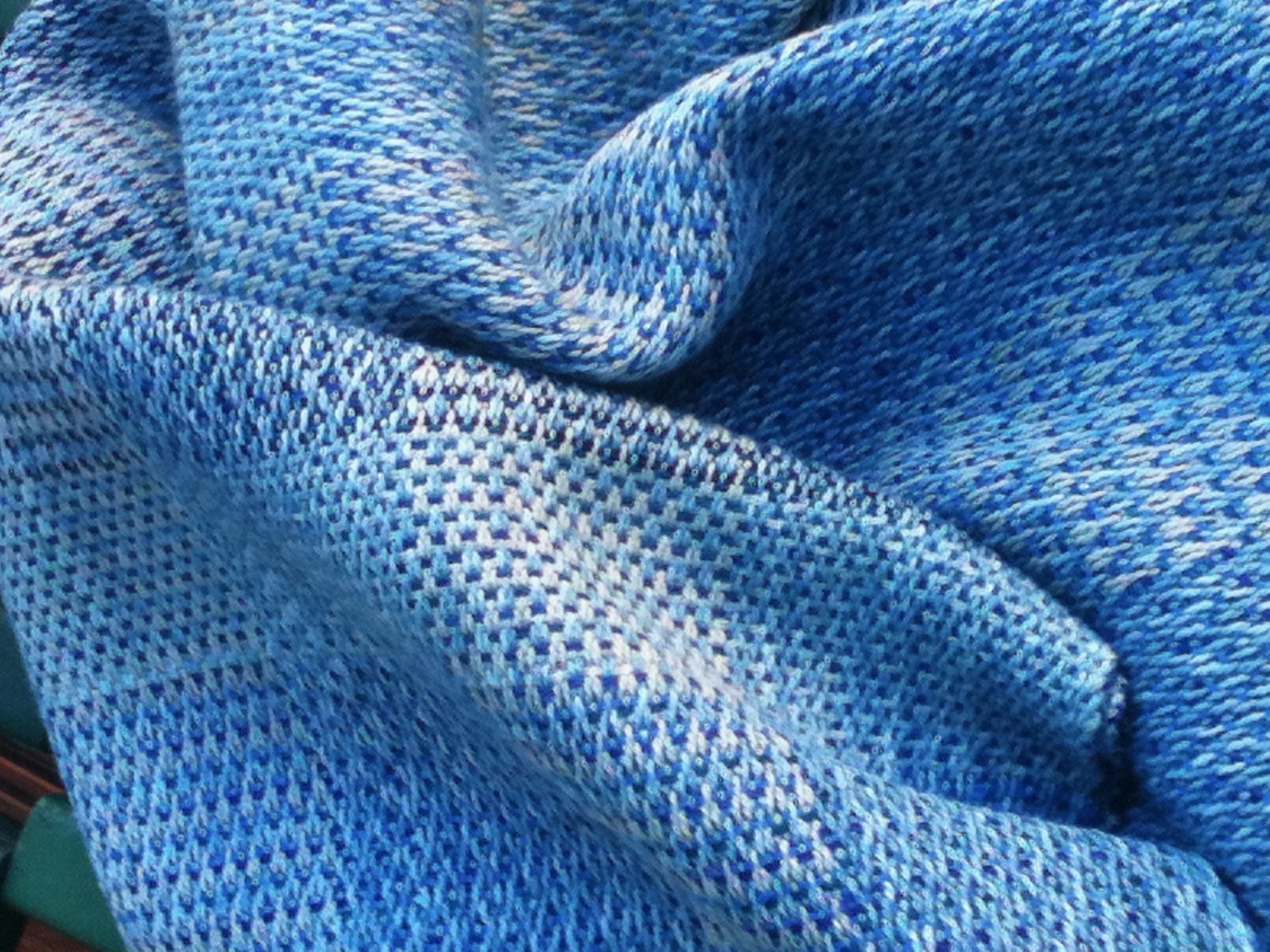
Episode #74
Jo Andrews
There are estimated to be over 40 million refugees in the world today and they are often seen as a drain on the societies that harbour them. They are frequently subjected to hatred and harassment. But this episode looks at what the first group of people ever to be known as refugees – the Huguenots of France – contributed to the country that gave them shelter and how they made British silk textiles famous.
Notes
Tessa Murdoch, can be found on Instagram: @tessavioletmurdoch. Tessa has written a book on the crafts that the Huguenot families excelled in. It is called Europe Divided: Huguenot Refugee Art and Culture. It is in the UK Haptic and Hue Bookshop and the US Haptic & hue Bookshop
Mary Schoeser is an acknowledged textile expert and co-founder of the School of Textiles in North Essex, UK. The School of Textiles issues a wonderfully informative newsletter which you can sign up for via their website. It also holds highly recommended study days and courses. The next event coming up is on Thursday, April 28th and it is on Sanderson Textiles. There are a few places left. You can find out more at https://www.schooloftextiles.co.uk/ The School of Textiles is on Instagram as @schooloftextiles.
Mary is the author of several authoritative books on textiles, including World Textiles, which you can find in the UK Bookshop and the US Bookshop. And Textiles: The Art of Mankind, which is also in both bookshops.
Barra Little is Chairman of The Spitalfields Trust – which is a building preservation trust that campaigns for the historic environment. They have done a good deal of work in East London but also now work beyond that area and take on other projects as well.
The Victoria and Albert Museum holds many pattern books and original designs for Spitalfields silk.
Many countries – as Tessa says in the podcast – have Huguenot resource centres. In the UK the Huguenot Museum in Rochester in Kent has been closed because of COVID, but they hope to re-open again shortly. If you want to find out more about your own Huguenot family that is an excellent place to start.
Kate Mosse, the author, has written two fiction books in a series about the Huguenots. The first is called The Burning Chambers in the Haptic and Hue UK Bookshop and in the Haptic & Hue US Bookshop and the second is called City of Tears, and so far, I can only find it in the UK.
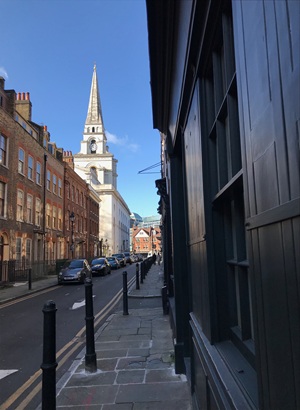
Spitalfields London
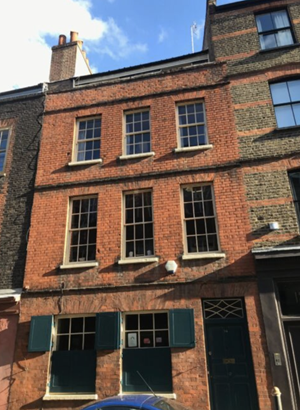
Weaver’s House Spitalfields
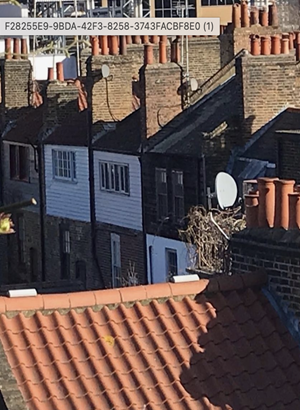
Weaver’s lofts from the back in Spitalfields
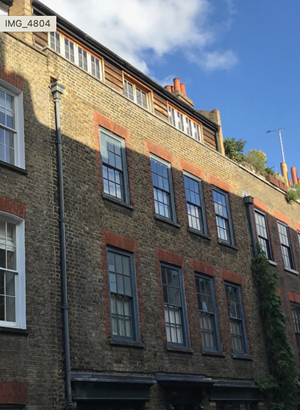
Weaving lofts from the street
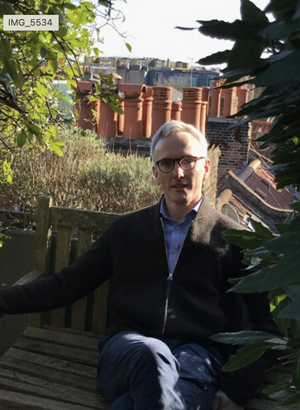
Barra Little, Spitalfields Trust
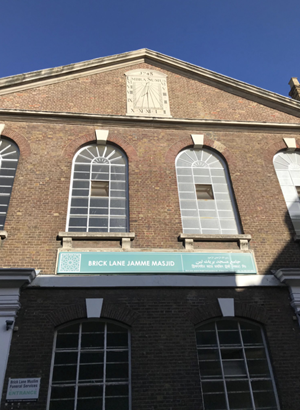
Jama Masjid Mosque
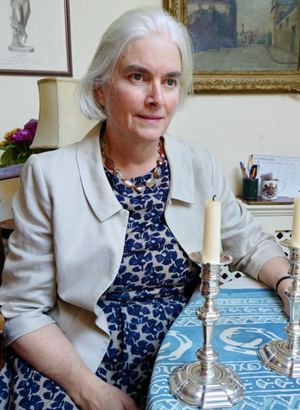
Tessa Murdoch
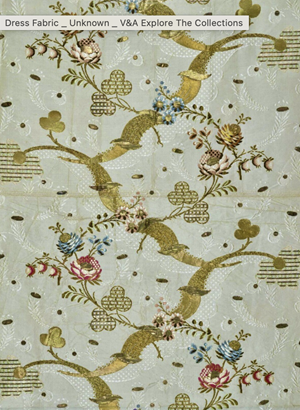
Spitalfields Silk in the V&A Collection
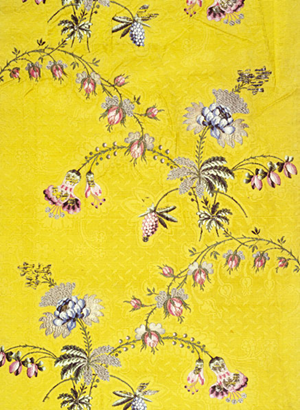
Spitalfields, James Leman Design
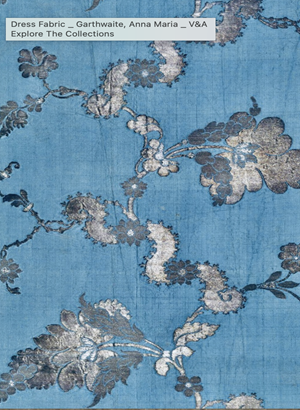
Dress Fabric – Anna Maria Garthwaite in the V&A Collection
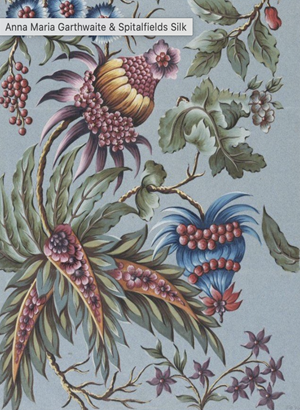
Anna Maria Garthwaite Design, courtesy of the V&A
Mary Schoeser
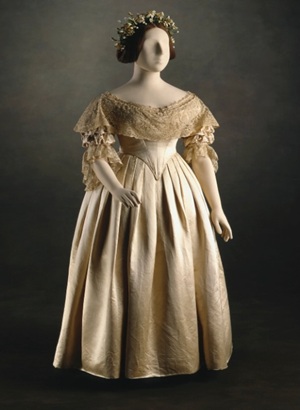
Queen Victoria’s Wedding Dress – courtesy of the Royal Collections
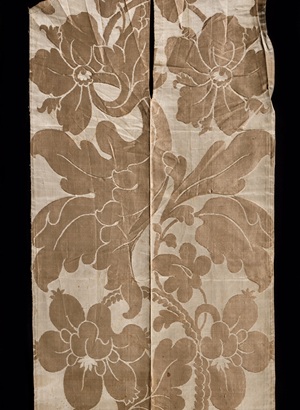
Martha Washington’s silk designed by Anna Maria Garthwaite
Script
The Fabric of The First Refugees
Jo: Welcome to Haptic and Hue’s Tales of Textiles. I’m jo Andrews a handweaver interested in the hidden stories textiles can tell us, particularly of those about whom the history books are often silent. Here are the makers and craftsmen and women who fashioned our cultures and economies, but who have long been forgotten. This episode pays tribute to a group of people who fled France for London in the 17th and 18th centuries and in doing so utterly changed the skilled textile output of Britain.
Jo: I’m standing in the middle of London on the edge of the city’s financial district in an area called Spitalfields on the corner of Brick Lane and Fournier Street, in front of a very plain brick building. These days, it’s the Jama Masjid mosque, but you can always peel back the layers of history in London. And we find that before it was a mosque, it was a synagogue serving the Jewish community that fled here from Russia and Eastern Europe in the 19th and 20th centuries. And then if you peel back another layer, we discover that this was first built as a church in the 1700s by the French Huguenots. In Spitalfields, the community settled here and they were skilled weavers. They were the first people in the world to be called refugees.
Jo Welcome to Haptic and Hue’s Tales of Textiles. I’m jo Andrews a handweaver interested in the hidden stories textiles tell us, particularly of those about whom the history books are often silent. Here are the makers and craftsmen and women who fashioned our cultures and economies, but who have long been forgotten. This episode pays tribute to a group of people who fled France for London in the 17th and 18th centuries and in doing so utterly changed the skilled textile output of Britain.
The French Huguenots settled east of the old city in an area called Spitalfields, and in doing so they shaped this area of London. It was because of their skill at draw loom weaving that Spitalfields silk became a byword for elegant and fabulously patterned and intensely colored silk cloth in the 18th and early 19th centuries. This was complex, well-designed fabric that could hold its own against material produced in France or Italy and was coveted around the world by those who could afford it. Even today, the mark of these weavers remains. Anyone can wander through this area and see the beautiful houses the Huguenot weavers built themselves. If you look up, the weaving lofts sit perched at the top of these houses. Barra Little, chair of the Spitalfields Trust, lives in a silk merchant’s house with a view over the whole district.
Barra: So here you’re standing on the roof of our house in a roof garden which overlooks Spitalfields to the east. You can see all of the rooftops of Spitalfields from here. This house is the, the tallest in the neighborhood, so we’re looking down on the weavers’ houses built between the 1720s and 1750s. To my left is a row of houses on Wilk Street, all of which have weaver’s lofts at the top of the house. And across from us, you can see the rooftops of Fournier Street, which is a mix of early and later Georgian houses. There are mixes of houses which are very much in the shape they were in when the Huguenots left and houses which have been changed over the years to accommodate new owners.
Jo: It always amazes me, the looms are so heavy and they’re getting them right up to the top of these houses, but then I suppose there was absolutely no electricity or nothing like that, so they had to do it.
Barra: You had to be up at the top to get the lights. You’re sitting here in, in, in a cold day, but with absolutely gorgeous sunshine and you can see the advantage of being up here to catch to catch the the, the rays and extend your day. These houses in some ways are, are fragile, but they are built with enormous internal beams. And so they would’ve been well able to handle the weight of the loom at the top of the house.
Jo: But as much as they made a success of their lives in London, the Huguenot weavers weren’t in the city by choice. They were forced migrants. And this episode is about how they became refugees and what they made of it. Their influence, not just on London and not just on cloth, has been profound. Nearly half of all US presidents have Huguenot ancestry. In many ways, they stand for the best of what migration brings a society. And in current circumstances, this is so much more than the dry and forgotten history of centuries ago. There is something profound in the story of the Huguenots, and there are many parallels that show us a light along the path in the anxious days in which we find ourselves, even when stories have dark beginnings, as this one does. 450 years ago in 1572, a wedding was held in France, the marriage of Henry of Navarre, a future king of France, to Margaret of Valois. It should have been a cause for celebration, but instead, it triggered Catholic mob violence, which resulted in the death of thousands of French Protestants and their families across France. Known as the St. Bartholomew’s Day Massacre, it set off the first wave of Protestant Huguenots fleeing to Amsterdam, Germany, Switzerland, and Britain. Tessa Murdoch, who has Huguenot ancestry herself and published a book last year on Huguenot refugee art and culture explains who they were.
Tessa: They were French followers of the Protestant reformer theologian, Jean Calvin whose dates of 1509 to 1564. The French Protestants came from all over France. By the mid 16th century, they had established centers. I think the first Protestant community was at Meaux and pretty soon after Paris, the Metropolis, where the first national Protestant Synod was held in 1559.
Jo: For more than a hundred years, the persecution in France ebbed and flowed, until in 1685, the Catholic French king definitively outlawed Protestantism, setting off an appalling wave of murder and terror.
Tessa: Well, interestingly, the persecution of the Huguenots builds up during the 1670s. So one of the most sort of vicious campaigns was the Dragonard, the billeting of soldiers on Protestant families who forced their hosts to convert, ate them out of house and home and destroyed their furnishings. If caught attempting to leave France, Huguenot men were sentenced to a lifetime’s penal servitude as galley slaves. So again, this resonates with the whole development of awareness of slavery. And we had Huguenot slaves operating in the Mediterranean, you know, in the back door of Europe, as it were. Women would be imprisoned or confined to Catholic convents, but perhaps the worst aspect was that any children captured were taken away from their parents and educated as Catholics in convents.
Jo: But despite the terrible dangers, many of them did manage to flee.
Tessa: They did escape, and there are many remarkable family stories about the way in which children were concealed in baskets of fruit or wine barrels. And then there are sort of accurate diary descriptions of how, for example, those families, I’m thinking particularly of the Perigal family who came from Dieppe, how they managed to cross the English Channel at night. And of course, many of these families had relatives who’d already managed to escape, which obviously encouraged them to aim and achieve this really very difficult journey. And there were established links between merchants, Huguenot merchants in Normandy, for example, particularly Rouen, which was effectively the Port of Paris with London. So these trading links were very important in helping Huguenot families to plan their journey effectively.
Jo: It’s very likely what’s happening today in a sense of people trying to cross the channel in small boats, isn’t it?
Tessa: Very much so. And I mean, I think in the last year, 2021, 25,000 refugees crossed the English channel in that way. And it is believed that of the some 50,000, probably more Huguenot refugees that made their home in the British Isles from the late 17th century into the early1 8th century, 25,000 settled in London, the British metropolis, when the total population of London was about 600,000. So it’s a considerable proportion of the local population.
Jo: These were the people who were first called refugia by the French, which translates into English as refugee. And down the years, that has become our universal word for anyone who flees persecution. Not all Huguenots came to Britain, and of those who did, not all came to London. Many settled first in Canterbury, Dover, and other parts of Kent. But despite the difficulties and the numbers, in the 1600s, there was an outpouring of support and sympathy for these refugees. Public money was collected in Britain and Ireland to support them, and by and large, they were welcomed by the government and the people.
Tessa: Well, surprisingly, they were, actually. If you remember that Charles II before the restoration of the monarchy had spent years of exile on the Continent in the low countries and in France. He was in terms of taste and aspiration, a great Francophile. And so he issued an edict of welcome in 1681, enabling Huguenots to bring in their stock in trade and tools duty free. In addition, there were house-to-house collections and the royally endorsed Royal Bounty provided grants for those most in need that were administered by an English and French committee through the original French Protestant Church, the Threadneedle Street Church in the heart of the city. They were welcomed, yet the many hundreds of craftsmen who settled here were able to demonstrate a higher level of skill and formal training than, than native equivalents. And there were petitions from English freemen, members of the city guilds, discouraging the admission of, they were described as necessitous strangers. But interestingly, the Goldsmiths Guild that I know well I’m happy to be a liveryman of, recognized the advantage of these foreign craftsmen, that their high level of skill would encourage the development of the native skillset. So they turned a blind eye eventually. And by, I suppose, by 1710, there were some 30 Huguenot Goldsmith masters accepted by the Goldsmiths Company.
Jo: Mary Schoeser, co-founder of the School of Textiles in North Essex in Britain, and a renowned expert on Spitalfields silk, draws a strong parallel between the reaction to the Huguenots and to Ukrainian refugees today.
Mary: What is it within humans that creates a sort of invisible bond? It’s a shared view of life. It’s a shared list of priorities. And so for the weavers, it was independence, a control of their own timing. Weavers were, were self-employed and they got paid by the piece rate and whatever. So that meant they were very proud of the fact that they had control of their working life and they had control of their apprentices and We’ve got independence, we’ve got a sense of self-determination, and we’ve got pride, skill, real skill you know, hard work belief in hard work. Now, that’s not too far a cry from what I think many people today feel deeply is something that we also see in the Ukraine. There is pride, there is hard work in this case against a terrible situation. There is a shared sense of the right way to do things. It’s less of a political alliance and more of a philosophical alliance that human beings have the right to determine their future and that those who work hard succeed.
Jo: The Huguenots tended to be skilled people, as well as weavers. They were lacemakers, goldsmiths, upholsterers, clock and watchmakers, and their workmanship was excellent. They were well-trained in the French guild system, and they were used to the demands of the stylish French court. Here’s Mary.
Mary: The Huguenots had the clientele of the Royal Court, the French court, and Louis XIV, in particular, was very determined that his courtiers would appear in the latest fashions constantly. Many say so that he kept them without funds to raise an army against him. That might be conjecture, but there, there is some logic behind that. And so, they had the clientele, and that’s always what counts in this story. It is the, the wealth is the royalty and the, the aristocrats who are supporting the work of those weavers like the Huguenot who are making the most elaborate cloths. And so, amongst those elaborate cloths, which were not commonly made, there was silk weaving already in Britain from the 16th century, but not brocades and not the very thick oh, scrunchy sort of cloths they’re called. So not the kind of things that essentially were requirements for attending the French court. And so they brought those skills with them, and that’s really what made the difference in the way the trade in Spitalfields began to be defined.
Jo: And in weaving, they transformed what Britain could produce and changed the nature of what was available to those who could afford it.
Mary: So what defines Spitalfields work is that they’re working with silk, and silk is the finest of fibers. So you can really draw with a, a silk on a loom, and it has to be a draw loom. And the draw loom was what the Huguenots really had extreme experience with because of their work for the court. So what did they look like? Well, they changed in fashion, of course, through time, but extraordinary, lace-like patterns, floral patterns big, hefty elaborate Baroque patterns before that. When we get into the middle of the 18th century the English do begin to develop a style that’s recognizably their own, that’s the, the cocoa style of very accurate, botanically drawn, light, little bouquets and sprigs and meanders of flowers and leaves. , And so the ground is left without much evident patterning, but when you look at it really closely, you can see this really skilled use of the fact that the draw loom can maneuver every thread, and you see really subtle single colored patterns, damask patterns, little textures, things like that. So, in a candlelit room these gowns with these lovely single-colored textured surfaces would have glistened as the cloth moved. So they were enticing and you know, they demanded attention, and that, of course, is what makes them perfect for court aristocratic occasions.
Jo: These fabrics took London, then Britain, and America by storm. Everyone wanted them, even in small pieces, enough for ribbons on your hat or a waistcoat if you were a man, Martha Washington had a dress made from fabric woven here and George Washington a silk waistcoat. Queen Victoria got married in a white Spitalfields silk dress, and many of the British royal babies have been christened in gown of the fabric since 1841. But to afford a whole dress in this silk, you had to have deep pockets, although you might get one secondhand.
Mary: Essentially, if you could get it, you would wear it. It was the pattern that was setting the fashion rather than the shape of the garment. And so these were gifted by royalty and aristocrats. They were gifted either to, you know, cousins or poor aunt or to their lady in waiting. And they often then went into the marketplace as secondhand clothes.
Jo: Mary says Spitalfields silk changed the way dresses were made. It was so expensive that no one wanted to cut into it, but instead, the dress was constructed round the silk.
Mary: Starting from the 1680s when the Huguenots arrived, their construction changes very little in that what they do is preserve entire lengths of cloth in the construction. There isn’t a lot of tailoring that kind of cut. You have lengths. The cloths are about 21 inches wide, and you have lengths as in the sack back, where it’s just big pleats at the neck, and then it flows down all the way to the floor. Now, that means that what you’re doing is also walking with your bank account on your back because that silk still has a value. And so you can, as I say, you can gift it generously or you can take it to a market or you can have a discussion with your, your tailor or whatever. So they had several lives, and it’s the magnificent Natalie Rothstein, the scholar now, no longer with us, who was able to establish that because she’s the one who studied every extent design for a Spitalfields cloths and was able to establish, went around the world and could point to a, a, a garment that had a provenance of say 1756 and say, “No, no, no, no, no, no.” But that pattern was designed in 1734, and I can show you the design for it, you see. So, you know, that really amplified what we understand about the provenance, the lifespan of these cloths, because silk is long-lasting. Its strength is, its tensile strength is stronger than steel. So as long as you’re kind to it it has a long life, and that’s part of that unconscious value that’s carried through this aristocratic circle and then filtering down.
Jo: This community over generations achieved enormous success, often using Mercers, cloth merchants as middlemen, Spitalfields acted as a magnet for other weavers of non-Huguenot descent who married into the families and continued the craft. It’s also because of the complexity of Spitalfields silk that we begin to see the first emergence of weave designers.
Mary: Centuries and centuries of tradition, and still to this day is that the weaver is the designer. You think about, you know, hand weavers and that sort of thing, that they’re designing things. But really what we’re talking about is a very subtle almost invisible expression of the coming of the industrial revolution. It’s about the division of labor. You get the development of the wealth of the master weavers and the Mercers, and it’s the master weavers who purchase the designs, sometimes on behalf of the Mercers, sometimes the Mercers themselves purchase design and put it to the master weaver that they’re working with. And then that design is translated. It has to go through a complex process of being drawn out onto squared paper, and then the loom has to be tied up in order to lift as per the design. And that can take two weeks, three weeks, four weeks, five weeks. It depends on how complex the design is, and that’s a specialist skill. , And so those exercises, if you like, begin to separate out in the way that Industrial Revolution does create skill-specific enterprises.
Jo: One of the people who we know first took up that opportunity was a Huguenot weaver called James Lemon.
Mary: He was apprenticed in Canterbury, but moved up to Spitalfields. Now, the Canterbury tradition still, that is late 17th century, was designer weaver. And then we watch it moving, and so what survives, the reason we know about James Lemon is it’s his designs that survive, and we know that in, he wasn’t necessarily always weaving them himself. And then you get to Annamaria Garthwaite, who must have understood the loom because you can’t design. It’s not like designing for print. Even today, really, you can’t design a complex weave without understanding the weave structure. But she then is, if you like, the first designer In for Spitalfields, and she moves to Spitalfields specifically to pursue that work.
Jo: Annamaria Garthwaite was an extraordinary figure, born in 1688, the daughter of a vicar with no Huguenot heritage. She was drawn to Spitalfields with her widowed sister and defying every stereotype of the day, earned her living as an independent woman. She designed more than a thousand patterns and was influential in creating a recognizably English style of silk design based on floral motifs and botanical drawings, and she was clearly a shrewd businesswoman. The Huguenots didn’t only deal in silk, they also had a profound impact on another yarn, linen. Louis Crommelin, a Huguenot born in Northern France to a family of flax growers, came to Northern Ireland in the late 1600s, and with the support of the king and queen, instituted a system for processing and weaving linen, as well as training local apprentices in how to produce high quality woven linen. He is often seen as the father of the Irish linen industry, and Huguenots have had an impact around the world. Here’s Tessa.
Tessa: The Huguenot Society published a roll of the Huguenots settled in the United Kingdom, which lists 500 Huguenot names, but also illustrates coats of arms for the leading Huguenot families, including the Bosanquets, the Bouveries, the Cazenoves, the Champion du Crespigny, Chevalier, De Boulet, Ligonier, Lafry, Luard, Majendie, Martineau, Papillon, Romilly, and Vilolle families. And if you want to find out more and whether your name is a Huguenot name, there are Huguenot Museums today in Berlin, in Rochester, Kent, adjacent to the French hospital, in Paris the Society for the History of French Protestant Library and Collection, in the Savan in France, and in USA, at Historic Huguenot Street, New Ports, Upstate New York, which claims to be the oldest continuously inhabited street in North America. And of course, in South Africa, there’s the Huguenot Museum in Franschoek. And there are Huguenot societies in Australia, in America, in France, and in Germany.
Jo: No fewer than 21 American presidents have Huguenot ancestry, including Joe Biden. Paul Revere of the famous Midnight Ride was a Boston goldsmith of Huguenot descent. David Crockett, Joan Crawford, Daphne Dumorier, Lawrence Olivier, Simon Lebon, Charlise Terron, Henry Longfellow, Gustav Faberge. The dizzying list goes on and on of those with ancestors who survived the persecution of the Huguenots. Back in Spitalfields, as soon as the railways came and weaving began the transition from craft to industry production, the Huguenots started to depart, although they did not leave weaving. They took their businesses out of London and set up thriving enterprises in places like Sudbury in Suffolk and Macclesfield in Cheshire, some of which survived into this century. With their departure, the noise of looms was heard no more, and Spitalfields rapidly became a Victorian slum. Although its days of textile production were not quite over, here’s Barra Little of the Spitalfields Trust.
Barra: So Spitalfields declined quite quickly, and these houses became houses for multiple families crammed into these spaces and stayed that way. There were waves of migrants. Huguenots moved out of Spitalfields. There was, in the 19th century, a big influx of Jewish migrants. And so, this neighborhood, which had been really dominated by Huguenot residents became almost entirely Jewish. That wave of migration in was followed by a wave of migration out of Spitalfields and another wave of Bangladeshi migrants in the 20th century. And these houses were actually, interestingly, returned to their original purpose, in a sense, which was mixed residential and commercial. They were what you might describe as sweatshops. This room was full of weaving equipment to make t-shirts and the like when it was first restored.
Jo: And as the Bangladeshi community began to move out in the later 20th century, the old weavers’ houses faced a new challenge.
Barra: Well, there was the threat of demolition that started the focus on these houses. They were, at that point, actually remarkably well preserved, but very much undervalued. And as the wave of migrants who were generally single workers filling these houses became more successful, the houses again were starting to empty, and they were under threat of demolition. On Elder Street, which is just across the street, a row of houses was in the process of being destroyed when the Spitalfields tried Trust founders decided to squat the houses to prevent their destruction. That was really at the beginning of a wave of awareness of conservation in this country and managed to attract a lot of support because these areas right at the core of London had been effectively forgotten about. , The trust was formed after the success of saving those two weavers houses and has gone on to save dozens of houses across Spitalfields London and now beyond.
Jo: Today, this is a thriving area filled with people who value the houses for their history. Sadly, there are no longer any weavers here, but Barra Little points out that they live on in the buildings they shaped and formed for their needs.
Barra: Well, we started in Spitalfields and you see as you learn the language of these houses, how weaving was really in- integral to the way they were built and used. And those skills have continued to be applied when we look at building projects. I first was involved with the trust because of very small houses down in Whitechapel which were entirely derelict and were about to be torn down. The trust stepped in to save those houses and added Weavers lofts to the houses to make them now new family homes. So we borrowed the, the, the language of the architecture from Spitalfields and applied them there. And those sorts of practical solutions to building is something that we really pride ourselves on. The reason we have Weavers lofts at the top of these houses is so that people working on the looms could catch the last of the daylight.And of course, today, it’s equally important to have spaces in which people can work and live catching the light. So we, I think we carry with us the history of the interaction between weavers and these buildings.
Jo: The story of the Huguenots has something to tell us about refugees, whoever they are and wherever they come from. Few of those who flee persecution have an easy passage, especially today when the world often seems tired of their plight. But as we look back at the Huguenots, it allows us to ask the questions born of hope. Can we see today’s refugees not just as victims, but ask as well, what do they bring us and what will they contribute to our societies in the future?
Thank you for listening to this episode. If you would like to see images of the Spitalfields Weaver’s lofts and some of the incredible silk they made or read a transcript of this podcast you will find these resources at www.hapticandhue.com/listen.
Haptic and Hue is hosted by me Jo Andrews. It is edited and produced by Bill Taylor and sound edited by Charles Lomas of Darkroom Productions. It is an independent podcast free of ads and sponsorship, supported entirely by its listeners, who generously fund us through Buy Me a Coffee or by becoming a Friend of Haptic & Hue.
In this month’s Travels with Textiles on Friends of Haptic and Hue – which goes out in two weeks’ time we will be talking to Victoria Bradley and Elizabeth Currie of the Victoria and Albert Museum in London who have edited an interesting and beautifully illustrated new book about women textile designers in the 20th century. This describes the challenges and difficulties these professionals faced to produce some of the designs that defined our lives and homes throughout the century. Find out who they were and how their work changed our lives in the next Friends of Haptic & Hue. We will also have brand new gifts for a October draw with the Friends newsletter. If you would like to know more then go to www.hapticandhue.com/join But until then its goodbye from me and enjoy whatever you are making.