

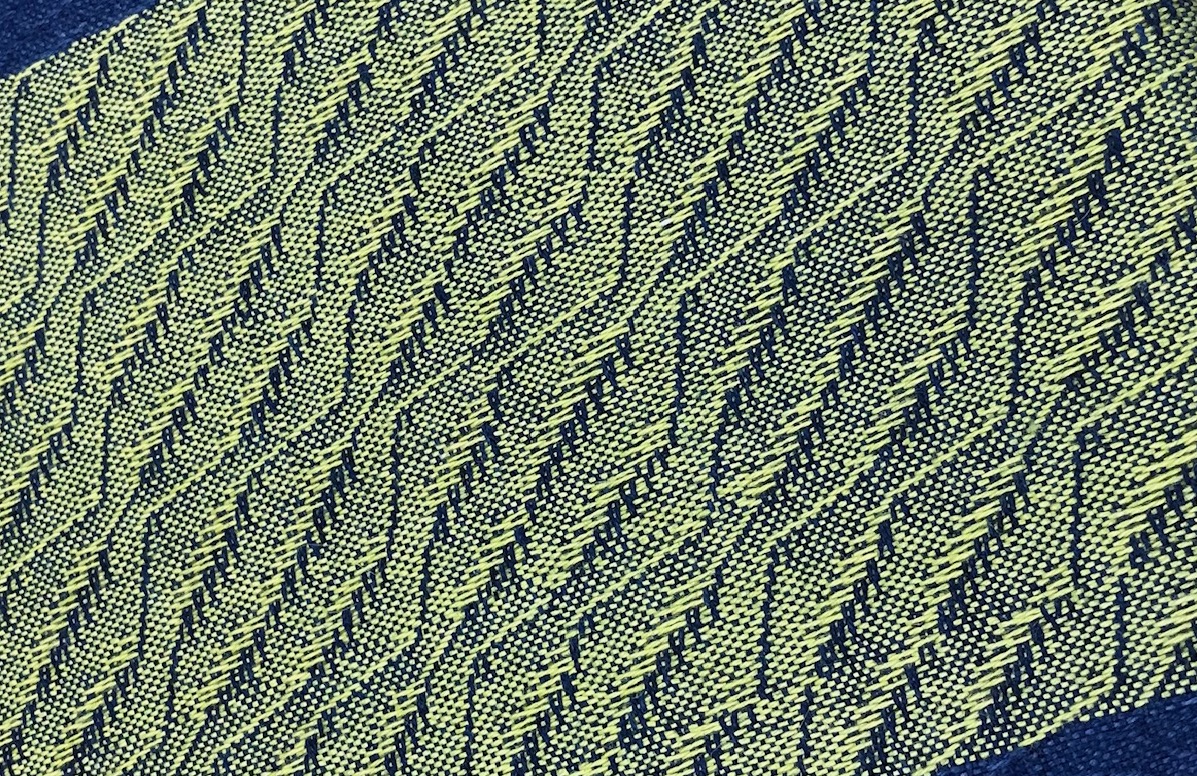
Episode #65
Jo Andrews
When colonial administrations in both Canada and the US tried to stamp out the culture of the First Nations people, the blankets and robes of the Coast Salish people were burnt, and the woolly dogs that had survived for millennia disappeared, to become just a memory. The very few blankets that do survive are held in museums and no longer belong to the community.
But new methods of analysing fibre and textiles are adding to the important oral histories of the Coast Salish families themselves and beginning to tell us more about the woolly dogs, where they came from, what they looked like, how old their lineage is, and how they were bred.
This episode is about what happened to the Coast Salish people and how important textiles are to our sense of identity. It is also about valuing both oral accounts and science in a ‘two eyed seeing’ approach to research.
Notes
If you want to know more there is a new book put together by Liz Hammond Kaarremaa and members of the Coast Salish community including Debra Sparrow. It is called The Teachings of Mutton and it is in the US Haptic & Hue Bookshop. It was allegedly published in the UK on October 30th 2025. But so far I have been unable to locate a copy.
Liz has her own website and blog at https://lizhk.ca/about/
If you live in the area there is a wonderful exhibition on at the Burke Museum in Seattle called Woven in Wool: Resilience in Coast Salish Weaving. It is on until August 2026. You can see Mutton’s pelt there.
If you are interested in Coast Salish weaving there is the Coast Salish Wool Weaving Center which is dedicated to furthering Coast Salish weaving traditions.
The description that accompanies Paul Kane’s circa 1850 picture of a Coast Salish Woman Weaving A Blanket gives us information about how the dog hair was used:
“The men wear no clothing in summer, and nothing but a blanket in winter, made either of dog’s hair alone, or dog’s hair and goose-down mixed, frayed cedar bark, or wild-goose skin, like the Chinooks. They have a peculiar breed of small dogs with long hair of a brownish black and a clear white. These dogs are bred for clothing purposes. The hair is cut off with a knife and mixed with goose-down and a little white earth, with a view of curing the feathers. This is then beaten together with sticks, and twisted into threads by rubbing it down the thigh with the palm of the hand, in the same way that a shoemaker forms his wax-end, after which it undergoes a second twisting on a distaff to increase its firmness. The cedar bark is frayed and twisted into threads in a similar manner. These threads are then woven into blankets by a very simple loom of their own contrivance. A single thread is wound over rollers at the top and bottom of a square frame, so as to form a continuous woof through which an alternate thread is carried by the hand, and pressed closely together by a sort of wooden comb; by turning the rollers every part of the woof is brought within reach of the weaver; by this means a bag is formed, open at each end, which being cut down makes a square blanket. The women wear only an apron of twisted cedar bark shreds, tied round the waist and hanging down in front only, almost to the knees. They however, use the blankets more than the men do.” (Paul Kane, “Wanderings of an Artist,” 1859:210–211) Courtesy of the Royal Ontario Museum.
Coast Salish blankets with dog hair in them are held in a number of museums around the world. In the UK, as far as I know, they are in the British Museum, the Pitt Rivers Museum, and Perth Museum in Scotland holds two of them. In the US, the Smithsonian in Washington DC holds several of these blankets, as well as the Burke Museum in Seattle. In Canada, the Museum of North Vancouver holds some as well.
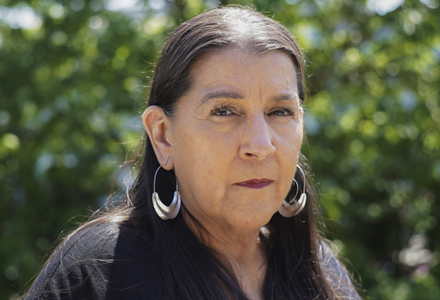
Debra Sparrow
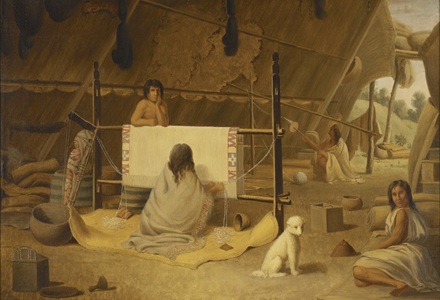
A Woman Weaving a Blanket by Paul Kane, circa 1850. Photo courtesy Royal Ontario Museum
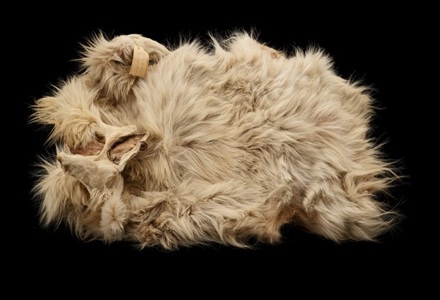
Mutton’s Pelt – Courtesy Smithsonian Museum
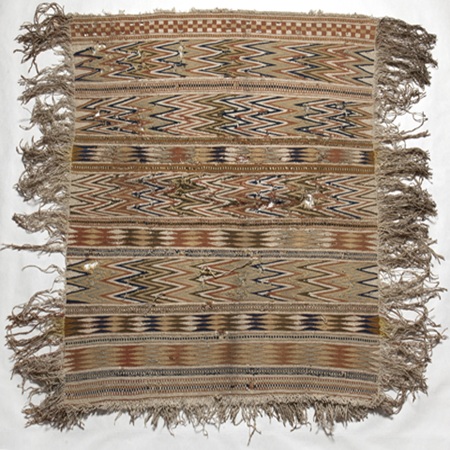
Coast Salish Dog Hair Blanket – Photo courtesy Perth Museum, Scotland
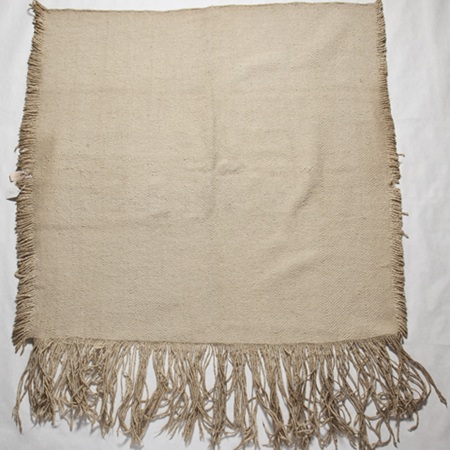
Coast Salish Blanket Containing Dog Hair – Photo Courtesy of Perth Museum, Scotland
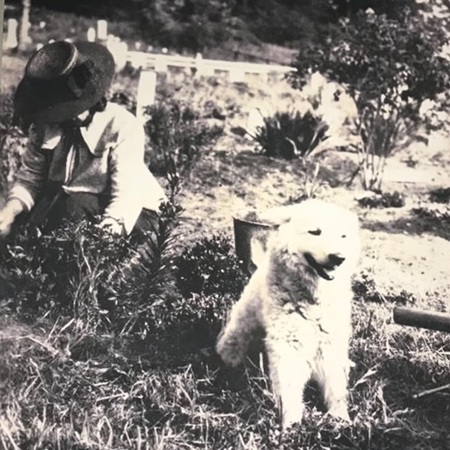
Ruth Shelton and her Dog circa 1922 – Possibly one of the last Coast Salish Woolly Dogs

Steven Point
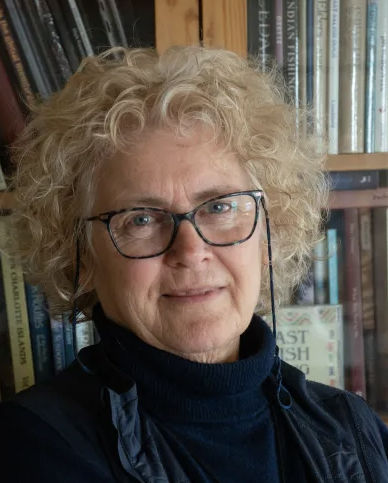
Liz Hammond Kaarremaa
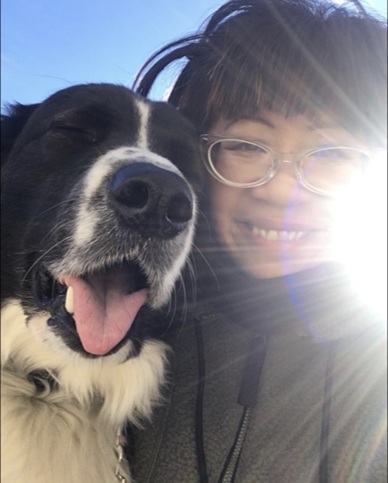
Audrey Lin and Pip
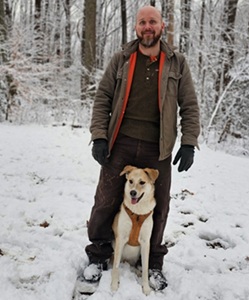
Logan Kistler and Tilly
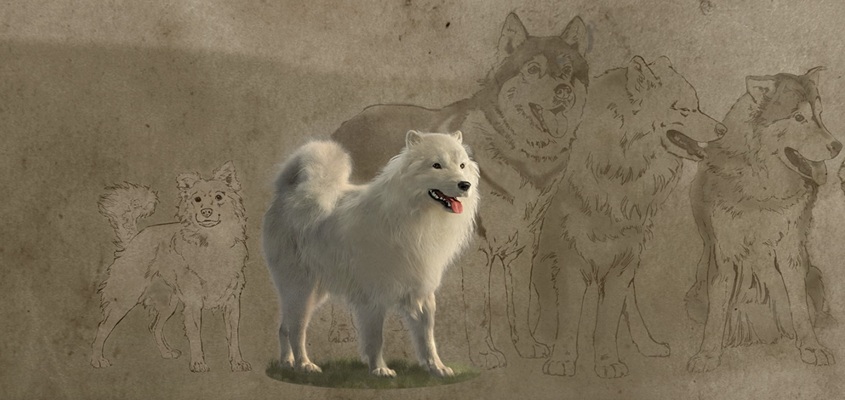
The Recreated Woolly Dog – By Karen Carr
Script
The Dog Hair Blankets of the Coast Salish People
JA: The lands of the Coast Salish people cross the border between Canada and America on the Pacific coast. It is a watery place of mountains, sea, and islands. There are more than forty different Coast Salish nations, people who have a common ancestral tongue, but now speak about 20 languages and dialects. They have been here for at least 10,000 years, and for much of that time, uniquely, they have bred dogs specifically for their fibre. Debra Sparrow is a Coast Salish Weaver and a member of the Musqueam people – her grandfather told her about the dogs.
Debra Sparrow: He said, you know there was this little wild domesticated animal, he pointed to the height of it. And he said, but this high. And he was right about 18 inches high. And he said everybody had them and we used them for the blankets. And so I was like, oh, really? And he’s like, yeah. And I kind of kicked myself now for not dabbling deeper into that conversation. Oh no, they’re gone extinct now, he said, but they looked like a fox almost. They weren’t a fox, but they looked like one.
JA: Pictures made by European artists at the time show a small appealing dog with a fluffy white coat and a straight nose.
Debra: It really is cute. The thing about it that I noticed the most is it had really tiny ears. It didn’t have big floppy ears or pointy ear. Well, they’re a little bit pointed sometimes, and a very curly tail.
JA: Welcome to Haptic & Hue’s Tales of Textiles. I’m Jo Andrews, a handweaver interested what textiles tell us about ourselves and our communities, stories that go far beyond the written word and often explore the lives of those who have little or no voice in official histories. That’s especially true in this episode which is about a people who flourished for thousands of years in north America with an oral tradition. There is very little written record and what there is, is unreliable and often wrong. Add to that the comprehensive attempt by the colonial authorities to snuff out the culture of the First Nations and it makes stories like these about the woolly dogs and the blankets made of their fibre precious ones:
Debra Sparrow’s grandfather told her that not only had he seen the dogs but he had also watched his grandmother making a blanket from their fibre for a special ceremony:
Debra: So he says, I didn’t know it then, but they were actually preparing all this work for my naming ceremony, which would take place a couple of weeks later. And he said, you know, it was like any little kid playing around. And every once in a while they’d kick me out because I was getting into mischief. And so, he was watching them and I thought, wow, like how amazing did I get to hear this? And then he said, about a couple of weeks or so later, they took me to my great-grandfather’s longhouse where he was very old and getting ready to leave and go to the spirit world. And he passed his name to me. And we went from there to our longhouse and we prepared and they blanketed me. They put the blanket around me, they laid out the white carpets. People came from all over, a couple of thousand people. And the ceremony began and he said, I never saw it again after that.
JA: Debra’s grandfather was given the name Shwe-emen. He was one of the last people to be named in like this in a traditional ceremony using the dog hair in blankets, after that weaving wasn’t done in his village: but his story did inspire his grand-daughter Debra, and her sister, as they started on the path learning to spin and weave:
Debra: There was this connection to our history that came through and we felt like it was part of our DNA that we were now becoming. And so, we embraced that and we always recognized our ancestors and our women, and we asked for guidance. And I still do. Every time I make a textile today, I ask for that guidance in them to be with me. This is not about making a pretty piece of art. It’s about my identity and the values with my history and the ability to wrap your people, to wrap society, to wrap the world as well and remind them of what we exist for. So when you get a name or you get married, even in a death, these blankets are laid out and you, stand on them depending on what the ceremony is. They’re wrapped in them. The ceremonies call witnesses. You ask for witnesses who are much like the lawyers in the room because they gotta remember everything orally. And you give everything away. When you’re done, everything’s given away. So, you have nothing again. But you have your dignity of how you are going to move in this world. So, these are attached to all the teachings of our, of our ways. So, it was a true blessing for us to be reintroduced to our, our textiles and our weaving that we knew nothing about. So, spending that time with him and learning that little bit gave me the grounding to keep moving.
JA: Steven Point is a former chief of the Skowkale First Nation and a former Lieutenant Governor of British Columbia.
Steven Point: Well, the only thing that we knew when we were growing up was that the dog had disappeared. My mother is a weaver. And when the weaving started being revived, I, I think in the late sixties or early sixties, they began bringing sheep’s wool to her. And my mom remembered the traditional dyes and whatnot, so she could colour the wool properly. But she told us a story then about the woolly dog, that, her grandmother had them, and that they kept them inside the longhouses that they lived in. They were small dogs and that they were domesticated, and that every year they cut their hair for the purposes of building these chiefs’ blankets. and only the chiefs could wear them. And they mixed the hair with the goat hair from the mountain and sometimes with the duck down. So, it was a very lengthy process, and one that the knowledge of which was passed from one generation to the next.
JA: For Steven the dog hair blankets were a vital symbol of authority
Steven Point: You know when the Queen came to visit the, the hereditary chiefs put their blankets on for her. They don’t do that for everybody. They put their hereditary chief’s blankets on, and we got pictures of them standing there. And so, they wanted to show who they were as in their own governance. They’re the leaders, they’re the spokesman for the people. They’re the fathers of the nation. They’re the ones that protect the people in war. And the symbol of their authority was the blanket. So incredibly important part of, of who we are as a people.
JA: And with the dogs gone that poses a problem
Steven Point: And so one of the things that the consequence of not having your chief blanket is that you don’t have the marker for you to show people that you are a chief, right? So as part of our right to self-governance it’s so important to, to remember these parts of our history and then revive them as best we can in modern day context.
JA: The Coast Salish People’s own history says that they bred the dogs for their hair for thousands of years, and that they kept these dogs separate from others, sometimes on Islands, to maintain the breeding lines. The knowledge of how to do this and how to spin and weave the fibre were secrets passed down the generations by women, until suddenly it stopped across the different Coast Salish nations in the late nineteenth and early twentieth century. The dogs died out and blankets ceased to be made. The colonial explanation was that wool arrived, it was easier to use and warmer, but that hides a much darker truth – one that explains why Debra’s grandfather took so long to talk to her about the little woolly dogs and his own naming ceremony.
Debra: And I’m sitting there going, tell me, what did you see? And he goes, well, I saw everything. And I said, how come you haven’t told me? And he said, you didn’t ask me. You see, that programming that had happened in residential school was still evident in an 83-year-old man that don’t pass this on.
Jo: Had he been to residential school?
Debra: Oh yes, absolutely. Oh yeah. That’s where they start programming them. You do not teach anything to do with your history and culture to your kids. Never. So, he didn’t, he said, go to school. I’m not telling you nothing. And that happened all over Canada, not just here.
JA: These were the schools that the First Nations families were forced to send their children to from the age of around 4 or 5. But Steven Point says the woolly dogs and the blankets disappeared in the context of a sustained assault on every aspect of the Coast Salish people’s culture:
Steven Point: Of course, when the missionaries arrived, they, they came shortly after the fur traders, and then gold was found in Fraser Valley here in 1858. And what happened was changing very people, a lot of government, a lot of church people and anthropologists thought the culture was dying. And, they felt like the, the native people would survive only if they, I think were civilized in some way, way, or brought into the broader culture, the Canadian culture. And so essentially the churches lobbied the government that ban the potlatch and ban the giving away of, of, of things in ceremony. And along with that, the, the ride across the country, drumming and singing, taking part in parades, having a drum in your house even was outlawed. It was against the law to practice your native culture. And so essentially the culture went underground. A lot of the ceremonies that used to be public ceremonies were held in secret in mountain places. And the elders whispered about the past.
JA: Steven says the Potlatch is the ceremony on which Coast Salish society and its governance turns. It is a legal, political and spiritual process all wrapped up in one. In an oral society it is the occasion where people are called upon to witness the passing on of hereditary titles, marriages, births, deaths and contracts.
At the same time as it was outlawed, sustained contact with Europeans brought disease to the Pacific North West as well.
Steven Point: And a lot of the cultural disruption happened not only because of the Indian Act amendments that banned the potlatch, but simply because our people were dying at an incredible rate. It’s been estimated that somewhere between 90 and 95% of our people died from contact with diseases brought by Europeans. I don’t think people can imagine what a holocaust that is in, in the United States. Can you imagine 90% of the people dying over a period of 10 years, perhaps? That’s incredible. and we’re still reeling from the shock, I think, of colonialism. We still haven’t gotten through the trauma of those impacts.
JA: And then there were the residential schools:
Steven Point: And what then happened, of course, is that Indian children were forcibly removed from their families by churches with the help of the RCMP and brought to residential schools. And in these institutions, they were not allowed to speak their language and their hair was cut. The clothing was taken from them. They weren’t allowed to go home during the school year. So, a lot of our children grew up in, in these sterile environments without having contact with their families. My mother was there for eight years. When she returned home, her grandmother was gone, passed away.
JA One of the causalities of that enormous burden of disease and cultural disruption was the woolly dog and the blankets made from its hair. Steven himself never saw a blanket in use.
Steven Point: No, they were already gone. The old blankets were just pictures in museum. We’d come through a time when the traditional regalia was confiscated by the church and the police when the potlatching was outlawed. And, and once that was outlawed, people hid their blankets. A lot of the blankets were burned and then some confiscated and put into museums. But it was against the law in those days after the late 18 hundreds, right up till 1951, when Indian Act was amended that it was against the law, in fact, to carry on your culture. So that was one of the main reasons why we lost connection to these blankets, was because of the Canadian Law.
JA There’s a black and white photo from 1922 of a woman called Ruth Shelton tending a cemetery on Coast Salish land and with her is a small fluffy white dog standing in front of the camera. This may be one of the last surviving woolly dogs: the inheritor of a tradition that persisted for thousands of years before becoming a story that was whispered only amongst the Coast Salish families. They knew the truth of these tales but for outsiders operating in a written culture, it became a kind of myth and one without much proof.
Liz Hammond Kaarremaa: I found a lot of references from explorers in the area who mentioned it. Strangely enough in a lot of museum collections when they acquired the blankets then there would be notes about dog wool in the blanket. And yet people didn’t believe that, at least in modern day, they didn’t believe it, that they wanted scientific proof. And I thought that was very strange. And Coast Salish oral history, you talk to Coast Salish people they always knew, in all the Coast Salish villages that, you know, wool dogs were kept. And I thought it was very strange that this disconnect between oral history even European history records and museum records, and yet there’s this doubt that was in the air that I, I felt was totally unjust. And it just didn’t make sense.
JA: Liz Hammond Kaarremaa lives on Coast Salish land and for 35 years worked at Vancouver Island University, where she was the Director of Research. She has been researching the woolly dogs and the blankets for over 15 years.
Liz: There’s very few blankets that seem to be mostly dog hair. So, dog hair could be used just in the fringe, or it could be used just as part of the warp or a braid that has been added on along the edges. There’s a one blanket at the Burke Museum in Seattle where the warp is elk or deer sinew and there’s also a little bit of white cotton string in there as well. But the sinew from the deer or elk, is very, very strong. And so that gives the warp a lot of strength. But then the whole weft is dog hair. There’s another blanket that seems to be a burial blanket. And it was a twill weave, and it’s both the warp and the weft seemed to be a dog hair. So, there’s a variety of ways. In some cases, it was the warp, in many cases, it was mixed with mountain goat wool. And then woven both as warp and weft.
JA: Liz has gathered many accounts from Coast Salish families about the dogs and the blankets and also information from written records.
Liz: The Cowichan people, for example, their traditional fishing area was up the Fraser River. So, they had to cross the Salish Sea, or what used to be called the Strait of Georgia, which is 22 miles wide. And then they would row up the river. A Hudson’s Bay Company employee wrote in his daily log when they were coming back down the river. He said a flotilla went by today. There must have been a hundred canoes, with each, canoe with a family, and at least half a dozen dogs in each canoe.
Jo: And we know these were the little white dogs and not the hunting dogs.
Liz: Yes. Because he had mentioned that they had recently been shorn.
Jo: Oh, isn’t that lovely? And so, we are catching glimpses of these dogs all the way through history.
Liz: Yes, for sure.
Jo: And yet there was this gap, people didn’t quite believe that the dogs existed, or that there were blankets made of the yarn.
Liz: It was interesting to see that in the 1800s it, it was common knowledge. Everybody accepted that dog wool was used and used in blankets. But in the later 20th century in, in an important and well written and well researched book on Salish weaving, the author, she said, you know, really, we need more scientific evidence. It was almost like the science was gaining prominence, in the 20th century, and the oral tradition was becoming less acknowledged. And so, this one person said, well, you know, I’ve examined most of the Coast Salish blankets in the world, and I’m looking forward to seeing one with dog wool, which is a <laugh> a nice way, but subtle way of saying, you know, I haven’t seen any yet, so where are they?
JA: Which is where Audrey Lin comes in:
Audrey Lin: I am an evolutionary molecular biologist. I use ancient DNA to learn more about the evolutionary history of animals, including dogs.
JA: Audrey found out during lockdown that the Smithsonian National Museum of Natural History, where she was working at the time, was holding in storage a full pelt of a Coast Salish Woolly dog, the only one in the world known to survive. It came from a dog called Mutton.
Audrey Lin: I was excited, very excited. And I also wanted to know if there had been any scientific, any genetic studies done on, on Mutton. That was my first initial reaction.
JA: The Smithsonian has a huge number of specimens in its natural history collection. In the dog section these are mostly bones. Having a full dog pelt is pretty unusual. Mutton arrived at the Smithsonian in 1859 sent there by a man called George Gibbs.
Audrey Lin: So he was a naturalist, he was an ethnologist, not ethnographer. He was hired by the United States government to help chart the boundary of what became the border of Canada and, the United States., He was hired because he had spent time in the Pacific Northwest before and had a really great aptitude for the languages there. During this time you also had all of these, colonial and, European explorers. They also fancied themselves naturalists and scientists. So, they are very, very interested in learning about the flora and the fauna that was there. So, this was also when the Smithsonian was sort of at its origins. It was the early years of the Smithsonian. So, he was collecting natural history specimens for the Museum and sending natural history specimens like fish and lizards and birds and, rocks <laugh> and sending all of that back.
JA: At some stage he acquired Mutton
Audrey Lin: We have no idea how he, he got Mutton. We can only speculate. I mean, in comparison to other similar sorts of colonial explorers at the time. He was one of the, I guess less problematic figures. So he did seem to have like a, a relatively positive relationship with the local peoples there. So, at some point he got Mutton.
JA: Sadly, Mutton did not lead a long and happy life with George Gibbs, he died of causes unknown while still a young dog and his pelt was sent to the Smithsonian, where more than 165 years later Audrey had plans for him:
Audrey Lin: So, I was primarily interested in finding out if Mutton was a pre-colonial or pre-contact indigenous dog. So these dogs they had come over with, with humans. Dogs were not independently domesticated in the Americas. They were brought over from, from Eurasia, We, we don’t know how the dogs came over exactly, but they did come over with people.
JA: Once the dogs arrived they were isolated and they became distinct to different regions of the Americas. Before the Europeans came there were lots of different kinds of dogs across the two continents.
Audrey Lin: Given how late in time the Europeans were in the Pacific Northwest, and also just from reading how, how the Coast Salish had maintained the, the practice of keeping woolly dogs like so late in time, and also knowing that Mutton what had been recorded in the archival records that he is the kind of dog that the natives there had used to make blankets out of. Like, I, I wondered if he was an indigenous North American, like pre-contact, pre-colonial dog. that was my, my first big initial question I wanted to answer.
Jo: And the answer was?
Audrey Lin: That he is <laugh> so he’s about, what is it? 84% pre-colonial indigenous dog. And about 16%, is European. So he does have like a little bit of, of mixing, but he is essentially a native dog.
JA: Mutton wasn’t a pure breed, but he is the nearest thing we have today to one. Audrey could also see from the analysis how old Mutton’s maternal lineage was:
Audrey Lin: And we estimate that it’s about 1800 to 4,800 years old. This doesn’t necessarily mean that that woolly dogs are, are that old, but it means that his particular ancestral lineage is that old.
JA: Now at this point the Coast Salish people might say: “well so what – we always knew that”. And at the centre of this is the clash between an oral culture and a written one. So much of textile knowledge has been passed down by word of mouth – it’s one of the reasons it remains buried, and often unrecorded. But from the start this project employed a methodology called a Two Eyed Seeing approach, where the Coast Salish people’s oral accounts were given equal weight to the science. Liz Hammond Kaarremaa explains how this works:
Liz: Well, it’s combining indigenous knowledge with scientific knowledge because for example, scientific knowledge, you could analyse the DNA, but you need the context for that. You need the cultural context and to talk about why. And so they wanted to do an approach where the indigenous knowledge was brought in with the scientific knowledge. And you end up with a with research that’s much more enriched, because of the two ways of knowing. Mutton’s, DNA anyway shows that his lineage, his ancestry, went back 2000 years, probably closer to 5,000 years. On the indigenous side, you’re hearing that it was so important to keep the wool dogs separate from the village or hunting dogs to keep the characteristics that they were breeding for long hair, the colour, white quick growing long growing wooliness which were recessive genes. Otherwise you’d lose the characteristics that you, you wanted. So the DNA is saying yes, the dog’s ancestry goes back at least, you know, two to 5,000 years. And on the indigenous side, you had the knowledge of how important it was, and you had to be breeding carefully. And that might be a reason why Mutton was allowed to be acquired by George Gibbs a non-indigenous white settler. We know that Mutton had 15%, or one great grandparent was a European dog, and maybe that little percentage was enough to make sure his, his wool quality wasn’t quite as good as being worthy of being kept and part of the breeding program.
JA: And the science told them something interesting: Logan Kistler is the Curator of Anthropology at the National Museum of Natural History in Washington. He extracted Mutton’s DNA from tissue samples with full permission from the Coast Salish and then analysed it:
Logan Kistler: The value of being able to look at the complete genome of any organism, and in particular this one is, is kind of twofold. One is you can compare that individual to the entire world out there of dogs and you can sort of plug him in and say, what does he look like? What does he not look like? How is he similar? How is he different? The other value is you can actually look at the genes, sort of the small packets of DNA that are actually responsible for how a dog looks, acts and, and lives. And you can learn something about sort of how that organism specifically is adapted to conditions. And in with those two things in mind, what we found first was Mutton was most closely related to other, unsurprisingly other native dogs from, from the Pacific Northwest going back several thousand years. So there’s a sort of long-term population legacy of dogs in the Americas that were essentially you know, driven to extinction following European colonialism. So, so there, there were dogs with essentially the first indigenous Americans and ever since up until the point of, of colonization. And then those, those dogs we know they inter bred with, with Eurasian dogs that arrived, and they were, they were just wiped out. So, Mutton was part of that lineage of that what we call the pre-colonial dogs PCDs. We, we found that his closest common ancestor were dogs living in British Columbia and Alaska. And, and that the separation between Mutton and those dogs was something between sort of two and 5,000 years. So, it was a, a bit of daylight between him and other dogs, which we reckoned is consistent with you know, that woolly dog breed being isolated for a significant period of time, which is, is consistent with how Salish people would tell it.
JA: And although it was not ideal, Logan and his colleagues could also see in the DNA something about the genes that gave the woolly dogs those long fluffy coats:
Logan Kistler: I was fully prepared to get no answers to that question because if you want to see what we would describe as signatures for selection, so parts of the genome that have been targeted to control traits like, you know, wooliness the, the real power of those sorts of tests is when you have a bunch of woolly dogs to look at and a bunch of not woolly dogs. We had one, we continue to only have one. And so we have to deploy really much more crude much more blunt instruments to, to try and ask this question. And yet we got 28 genes giving us a signal that said, like, this dog is different from all of the dogs in, in a specific way. And those genes are associated with hair traits, skin traits. There’s one gene called Kank 2 that gene is associated with, with particular hair traits in, in humans not associated with ancestry. You know, there’s, there’s all kinds of, of diverse hair textures in humans all over the world. We’re not talking about that sort of hair trait. We’re talking about it sort of a, what we call pathogenic hair trade. So, if someone, regardless of ancestry has this characteristic gene pattern then they’re sometimes described as having a woolly hair phenotype. So we, we found a gene under selection in Mutton that is associated with woolly hair in humans. And genes in that same gene family are also been implicated in woolly mammoth evolution. even though we only have this one dog, we can see these really clear signals for, for something going on. Keratin, there’s a keratin gene under selection. That’s the, that’s the stuff hair is made of. And so we, we, you know, I think with, with a lot more dogs, we could still put a lot more subtlety to it, but the way that then I, I sort of thought about this is, you know, we’ve got this bluntest of, of analytical instruments because we only have one dog, and yet we still see this thing light up like a Christmas tree in terms of, of important signal. And what that tells me is we are looking at a, a dog that has been specially managed for a long time you know, this is very consistent with thousands of years of, of very dedicated breeding and care.
JA: With all this information they were able to create a likeness of Mutton:
Logan: So we worked with a forensic artist who’s actually done reconstructions for our human origins hall who actually turns out to be a fibre artist and, and keeps fibre animals and said, Hey, can you, can you, you know, create us a, a lifelike reconstruction with this dog? And so she got together with us virtually, she’s in, in New Mexico. The mammals curator, Audrey and I , all went in to see Mutton, and she, she was on zoom with us and said, okay, now measure the distance from the base of his two ears. Now measure the distance from this to this. We took dozens of measurements on Mutton’s pelt, Then she took a 3D scan from an archaeological dog from British Columbia, which is thought to be related to these woolly dogs. And she was able to use that to sort of build a face shape. And then she added some, some fur and added some, you know, added a little smile and, and gave us a, just a fantastic idea of what what Mutton might’ve looked like in life. It looks a little like a small Samoyed. And that’s sort of what, what most people go to.
JA: And although Logan isn’t a fibre artist himself he is one of the few people who has spent a lot of time around Mutton and I wondered how the pelt looked to him:
Logan: Looking at Mutton’s pelt, his undercoat, it wants to make yarn, it wants to spin up you can tell it looks grippy, it looks very soft. The undercoat is actually significantly longer than the top coat, than the guard hair. So that’s kind of seems to be one of the characteristics of this is you get these massive sort of three or four inch undercoat out. Whereas like in, in my, you know, insane husky dog, that, that all just blows out and gets all over my house.
JA: Mutton’s pelt is currently at the Burke Museum in Seattle as part of an exhibition called Woven in Wool: Resilience in Coast Salish Weaving. He’ll be there until next August if you are able to visit. There are no plans to clone him and there is no way of bringing back the woolly dogs – they are sadly gone forever. But the DNA of one dog it gives scientists a baseline for the remains of other dogs to be compared against, for blankets around the world to be tested to see if they are made with dog hair and how old they are, and for more information to be gathered. Here’s Liz Hammond Kaaremmaa
Liz: I don’t know how it’ll change for the Coast Salish people. You know, that’s a really good question for them. It’ll certainly bring the knowledge about the dogs up more and hopefully maybe it’ll inspire more oral history coming out and being shared in their communities. But for the non-indigenous communities, I think Mutton is a really good doorway into understanding a bit more about the culture and the impact of colonial policies. People think it’s, oh, it was just residential schools, but that was just one aspect, you know, it was a lot of policies that impacted and I think people will come to be a bit more aware of that.
JA: It astonishes me that textiles remain such fragile things and yet such indestructible repositories of culture and tradition. For Debra Sparrow, the Coast Salish Weaver, the story of little dog remains a gift in her life.
Debra: It all goes back to the woolly dog. All of it. For which we wouldn’t have been warm, we wouldn’t have had this existence because it gifted to us. And that’s the honour that I feel about it, is every day I’m honoured, every day. I’m grateful for this information that flows from the universe to us still today. And, we have to pay attention to that, to the fibres of the land and of life throughout this whole world and country that we are at a very crucial place. And I think the balance between what was and what is and knowing who you are and where you come from, is our saving grace.
JA: Thank you for listening to this episode. Great thanks are owed to Liz Hammond Kaarremaa who was instrumental in helping me speak to the interviewees you heard here, Debra Sparrow, Steven Point, Audey Lin and Logan Kisler. Many thanks to all of them for agreeing to take part despite shutdowns and very busy schedules.
If you would like to see pictures of Mutton, other woolly dogs and dog hair blankets, head over to www.hapticandhue.com/listen and look for Series Seven. Haptic and Hue is hosted by me Jo Andrews. It is edited and produced by Bill Taylor and sound edited by Charles Lomas of Darkroom Productions. It is an independent podcast free of ads and sponsorship, supported entirely by its listeners, who generously fund us through Buy Me a Coffee or by becoming a Friend of Haptic & Hue. Friends get access to free textile gifts every month and an extra podcast hosted by me and Bill Taylor, where we cover interesting events and the textile news of the day. To join Friends, go to www.hapticandhue.com/join
This is the last episode in Season Seven so I hope you have a wonderful celebration at the end of the year and please enjoy whatever you are making.